Part of: Banknote Types & Materials
This article is part of the Banknote Types & Materials hub, covering how banknotes are designed, produced, and classified.
How banknotes are made involves a sophisticated multi-stage process combining artistic design, advanced security engineering, and precision manufacturing. From initial concept to circulation, producing currency requires specialized facilities, proprietary technologies, and strict security protocols that make banknotes among the most complex documents manufactured today.
This comprehensive guide explains the complete production process for both paper and polymer banknotes, revealing how central banks and security printing companies transform design concepts into currency. According to the U.S. Bureau of Engraving and Printing, producing approximately 7 to 9 billion notes annually requires continuous 24-hour operations using technologies unavailable to ordinary printing facilities.

Stage 1: Concept Development and Design Planning
Establishing Design Objectives
The banknote creation process typically begins months or years before production with extensive planning by central bank committees, security experts, and design teams. Key considerations include:
- Cultural representation: Selecting portraits, landmarks, symbols, and themes that reflect national identity and values
- Denomination differentiation: Ensuring each value is immediately distinguishable through size, color, and design elements
- Accessibility requirements: Incorporating features that help visually impaired users identify notes
- Security integration: Planning where to place watermarks, threads, holograms, and other protective features
- Substrate selection: Deciding between paper or polymer based on climate, costs, and performance requirements
Artistic Creation
Specialized artists create detailed illustrations and layouts that will form the note’s visual identity. Unlike ordinary graphic design, banknote artwork must accommodate security features while maintaining aesthetic appeal. Artists work closely with engravers who will ultimately translate designs into printing plates, ensuring that artistic vision aligns with technical production capabilities.
Stage 2: Substrate Production
The foundation of any banknote—its substrate—must be produced before printing can begin. The manufacturing process differs significantly between paper and polymer substrates:
Paper Banknote Substrates
Traditional banknote paper begins with cotton fibers, often blended with linen or other textile materials. The substrate manufacturing process includes:
- Fiber preparation: Cotton linters (short fibers from cotton seeds) are processed into pulp and mixed with water to create a suspension
- Watermark creation: A shaped wire screen called a dandy roll presses against wet pulp during sheet formation, creating density variations that become visible watermarks
- Security thread insertion: Polyester or metallic threads are positioned within the paper structure as sheets form, becoming embedded rather than applied
- Drying and finishing: Sheets are dried, pressed, and treated with special coatings that prevent fluorescence under UV light—ordinary paper glows, banknote paper does not
The resulting substrate has distinctive texture, strength, and embedded security features impossible to replicate with ordinary paper-making equipment.
Polymer Banknote Substrates
Polymer banknotes begin as biaxially oriented polypropylene (BOPP) film produced through a specialized process:
- Polymer pellet melting: Polypropylene pellets are melted and extruded into a molten tube or «bubble»
- Biaxial orientation: The bubble is stretched simultaneously in two perpendicular directions, creating exceptional strength and dimensional stability
- Opacification: White pigment is applied to create printable opaque areas while leaving selected sections transparent for security windows
- Surface treatment: Multiple coating layers are applied to create surfaces compatible with various printing inks and techniques
The transparent windows achievable in polymer—impossible with paper—become distinctive security features unique to polymer substrates.
Stage 3: Plate and Cylinder Preparation
Before actual printing, approved designs must be converted into physical printing plates and cylinders:
Intaglio Plate Engraving
Intaglio printing—which creates the raised texture characteristic of banknotes—requires engraved metal plates. Master engravers use specialized tools to cut designs into hardened steel plates with microscopic precision. These plates are then chrome-plated for durability and may be used to create working plates for production runs.
Offset Printing Cylinders
Background patterns, fine details, and color elements typically print via offset lithography, which requires creating printing cylinders through photographic or laser engraving processes. Modern facilities may use computer-to-plate technologies that transfer digital designs directly onto printing surfaces.
Stage 4: Multi-Stage Printing Process
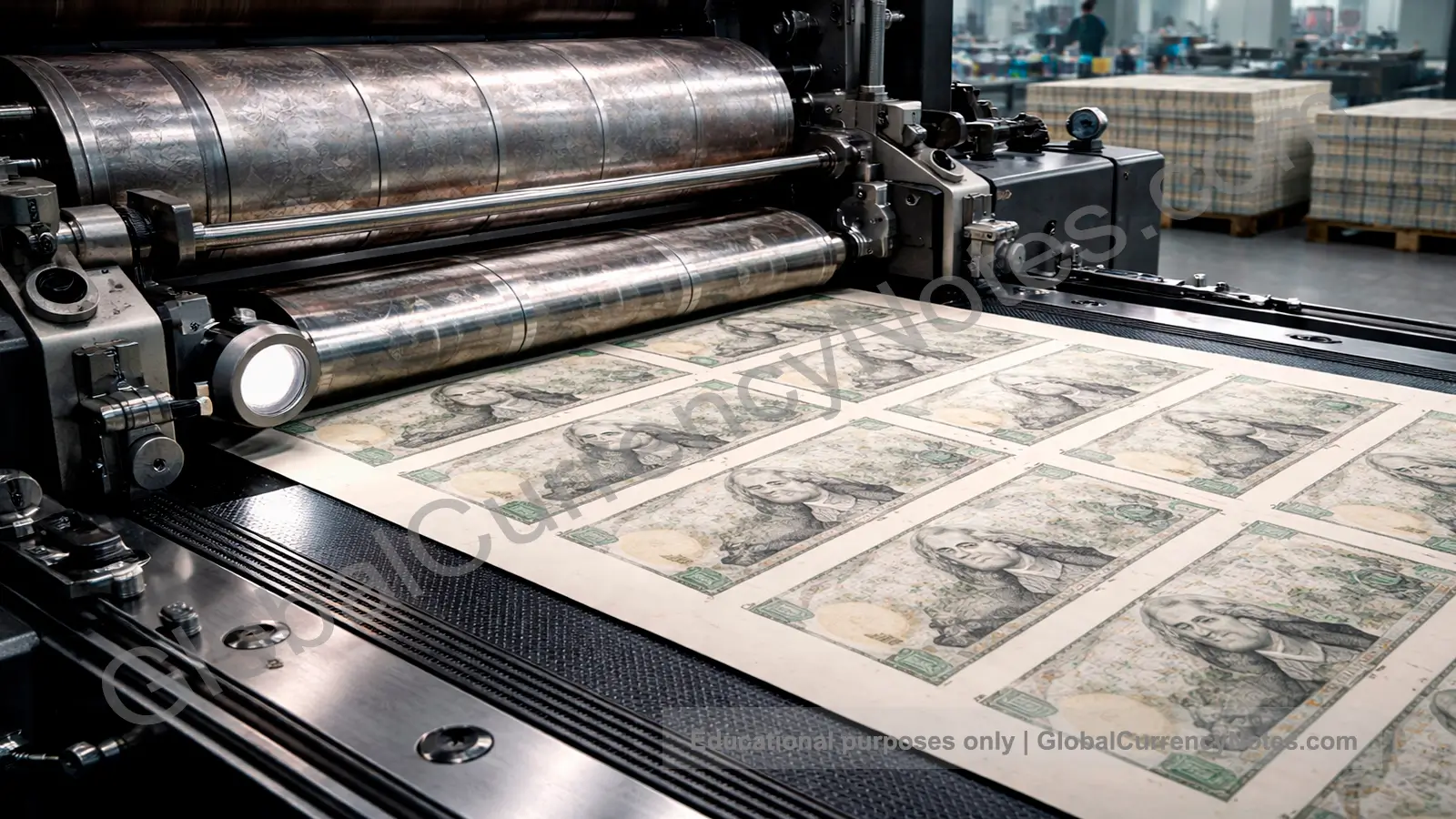
Banknote printing combines multiple specialized techniques, each contributing specific visual and security characteristics:
Offset Lithography
The first printing stage typically involves offset lithography, which applies background colors, patterns, and fine details. This technique works by transferring ink from printing plates to rubber blankets, then to the substrate. Offset printing provides:
- Precise color registration across multiple colors
- Fine detail reproduction in background patterns
- Continuous-tone images and gradients
- Efficient high-speed production
Intaglio Printing
Intaglio represents the most distinctive banknote printing technique. Engraved plates are covered with ink, then wiped so ink remains only in recessed areas. Extreme pressure—up to approximately 20 tons in some systems—forces substrate into these recesses, transferring ink deposits that stand slightly above the surface.
This process creates the characteristic raised texture detectable by touch, particularly noticeable on portraits and large denomination numbers. Intaglio is extremely difficult to counterfeit because it requires:
- Precisely engraved plates
- Specialized inks with specific viscosity
- High-pressure printing equipment
- Expert press operation
Additional Printing Technologies
Modern banknotes may incorporate several additional printing methods:
- Screen printing: Applies thick ink layers for certain security features
- Letterpress: Prints serial numbers and other variable information
- Flexography: Used for some polymer note applications
Stage 5: Security Feature Application
Beyond printing, specialized equipment applies additional security elements:
Holographic Elements
Holographic foils or patches are die-cut and applied to specific note locations using heat and pressure. These elements incorporate multiple optical layers creating three-dimensional images visible from different angles. Application requires precise positioning and bonding to prevent delamination.
Optically Variable Ink (OVI)
Color-shifting inks containing microscopic optical pigments are printed in designated areas—commonly denomination numbers. These inks change color when the note is tilted, creating an effect nearly impossible to reproduce photographically or with standard printing.
Ultraviolet and Infrared Features
Special inks visible only under UV illumination or to infrared sensors are applied to create authentication features detectable by machines and verification devices but invisible under normal lighting.
Stage 6: Numbering and Finishing
After main printing completes, notes receive unique identification and final treatments:
Serial Number Application
Each banknote receives a unique serial number printed via letterpress or inkjet technology. Numbering systems vary by country but typically include letter prefixes indicating print series or production facilities, followed by numeric sequences. This serialization enables tracking and authentication while preventing duplicate notes.
Coating and Varnishing
Protective coatings may be applied to enhance durability, prevent dirt accumulation, and protect printed features from abrasion. Polymer notes may receive additional surface treatments to adjust handling characteristics.
Stage 7: Quality Control and Inspection
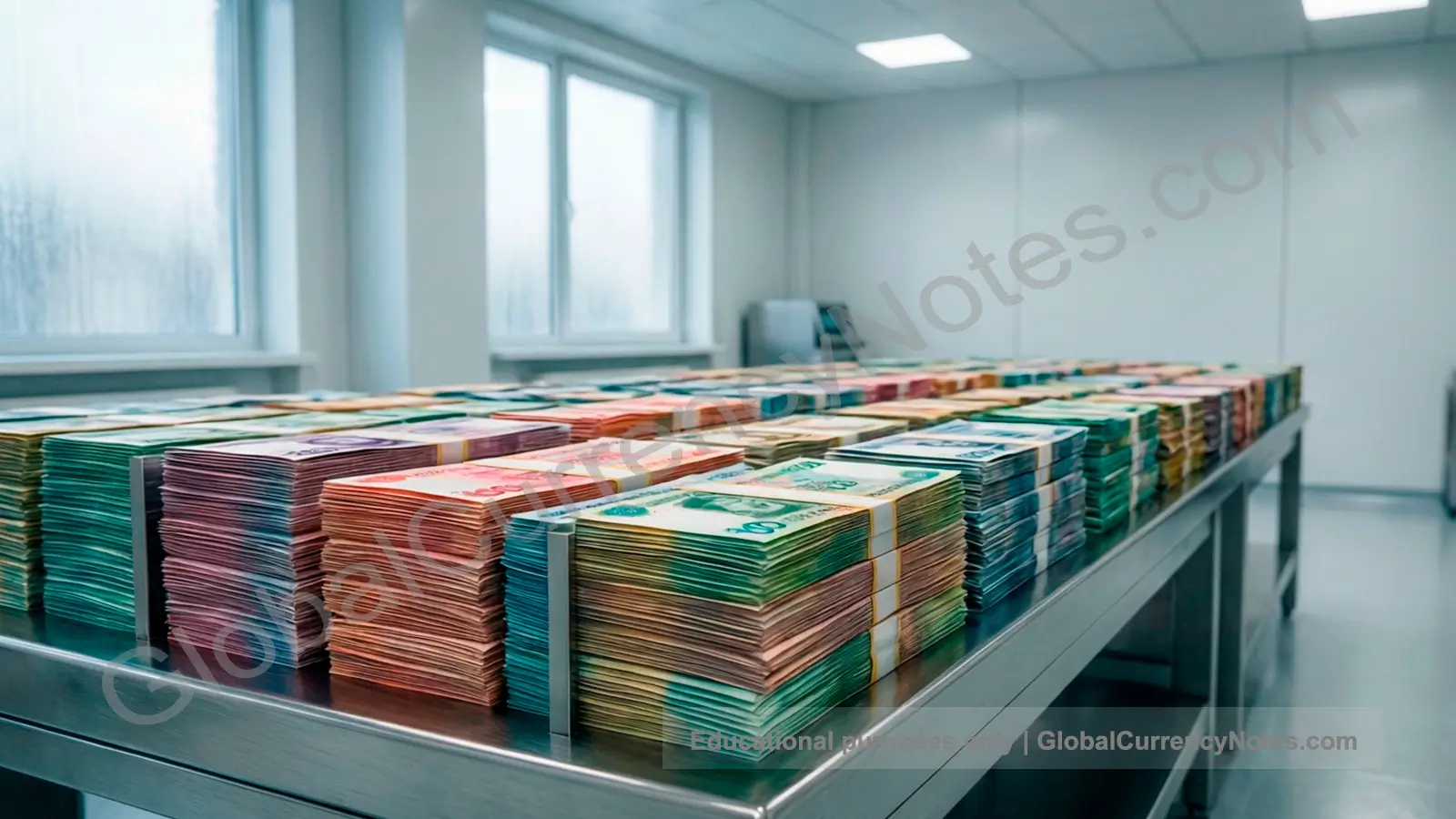
Quality control represents a critical stage ensuring only perfect notes enter circulation:
Automated Inspection
High-speed cameras and sensors examine every printed sheet, checking:
- Print registration and color accuracy
- Security feature presence and positioning
- Substrate integrity and cleanliness
- Serial number legibility and uniqueness
Automated systems can inspect thousands of sheets per hour, identifying defects invisible to human inspectors operating at production speeds.
Defect Removal
Notes failing inspection are marked and later removed from production runs. Rejected notes are typically shredded or otherwise destroyed under controlled conditions with documented accounting to prevent any defective currency from reaching circulation.
Statistical Process Control
Beyond individual note inspection, production facilities monitor statistical quality metrics to identify trends, adjust processes, and maintain consistent output meeting central bank specifications.
Stage 8: Cutting and Packaging
Approved sheets containing multiple notes are precisely cut into individual banknotes using specialized guillotines. Cut notes are then:
- Counted into bundles (typically 100 notes per bundle)
- Bundled and wrapped in protective packaging
- Packed into larger containers with documented serial number ranges
- Sealed with tamper-evident features
Throughout this process, strict security protocols and dual-control procedures prevent theft or unauthorized access.
Stage 9: Distribution to Central Banks
Completed banknotes are transported under armed guard to central bank vaults where they are:
- Received and verified against production documentation
- Stored in secure facilities until needed
- Distributed to commercial banks based on circulation demand
Central banks maintain strategic reserves of banknotes in various denominations, releasing new notes to replace worn currency and meet seasonal demand fluctuations.
Stage 10: Release Into Circulation
Commercial banks order banknotes from central banks to meet customer demand for cash. New notes enter circulation through:
- ATM replenishment
- Bank branch cash supplies
- Commercial customer cash orders
- Retail and business banking services
Once in public hands, banknotes circulate through countless transactions until wear necessitates their return to central banks for replacement, completing the currency lifecycle.
Production Timeline and Scale
The complete process from design initiation to circulation typically spans:
- Design and development: Typically 2 to 5 years for new note series
- Substrate production: Continuous production based on printing schedules
- Printing and finishing: Several weeks from raw substrate to finished notes
- Quality control and distribution: Days to weeks depending on quantities and logistics
Major security printing facilities produce billions of banknotes annually. For perspective, the U.S. Bureau of Engraving and Printing produces approximately 7 to 9 billion notes per year, while suppliers for the Bank of England produce around 2 billion notes annually.
Security and Confidentiality
Banknote production facilities operate under extraordinary security measures:
- Physical security: Controlled access, surveillance, and armed guards
- Personnel vetting: Background checks and continuous monitoring of employees
- Process segregation: Different stages separated to limit knowledge and access
- Material tracking: Every substrate sheet and finished note accounted for
- Technology protection: Proprietary processes and equipment not publicly disclosed
Many technical details of security feature production remain confidential to maintain their effectiveness against counterfeiting.
Differences: Paper vs Polymer Production
While the overall process flow remains similar, paper and polymer production differ in specific aspects:
Paper-Specific Considerations
- Watermark integration during substrate formation
- Security thread embedding in paper structure
- Moisture control throughout production
- Traditional intaglio compatibility
Polymer-Specific Considerations
- Transparent window formation during substrate production
- Different coating requirements for ink adhesion
- Modified printing pressures and temperatures
- Static electricity management during handling
Production facilities transitioning from paper to polymer typically require significant equipment modifications and process adjustments.
Major Security Printing Companies
While some countries operate government printing facilities, many central banks contract with specialized companies including:
- De La Rue (UK): One of the world’s largest commercial security printers
- Giesecke+Devrient (Germany): Produces currency for numerous countries worldwide
- Orell Füssli (Switzerland): Specializes in high-security printing
- Crane Currency (USA): Produces specialized security substrates and features
Government-operated facilities include the U.S. Bureau of Engraving and Printing, Japan’s National Printing Bureau, and similar organizations in other countries maintaining domestic production capabilities.
Frequently Asked Questions
How long does it take to produce a banknote from start to finish?
The printing and finishing stages typically require several weeks from raw substrate to completed notes ready for distribution. However, if you include design development and testing, new note series may take approximately 2 to 5 years from initial concept to first circulation. Once production infrastructure is established, ongoing manufacturing operates on rolling schedules producing millions of notes continuously. Timelines vary significantly by country and project scope.
Why are banknote printing facilities so heavily secured?
Security prevents theft of currency, substrates, or production equipment that could enable counterfeiting. Facilities contain proprietary technologies and processes that must remain confidential to maintain effectiveness against counterfeiters. Additionally, strict material accounting ensures that every substrate sheet and finished note is tracked, preventing unauthorized notes from entering circulation.
Can ordinary printers replicate banknote printing techniques?
No. Banknote production requires specialized equipment, materials, and expertise unavailable to typical printing operations. Intaglio printing demands precisely engraved plates and presses capable of extreme pressure. Security substrates with embedded features cannot be purchased commercially. Optically variable inks and holographic elements involve proprietary technologies. This complexity is intentional—making counterfeiting economically impractical for most potential counterfeiters.
How often are banknote designs changed or updated?
Major redesigns typically occur every 7 to 15 years, though timing varies significantly by country and currency. Changes may be driven by advancing counterfeiting techniques requiring new security features, desire to update visual design, substrate transitions (paper to polymer), or commemoration of significant events. Some currencies implement incremental updates to specific denominations rather than redesigning entire series simultaneously.
What happens to printing plates and production materials after use?
Used printing plates, especially intaglio plates containing detailed engravings, are destroyed under controlled conditions to prevent unauthorized reproduction. Similarly, substrate waste, rejected notes, and other production materials are accounted for and destroyed. This prevents any production materials from potentially being used for counterfeiting purposes.
Do all countries print their own banknotes?
No. While larger economies often maintain government printing facilities, many smaller countries contract with commercial security printing companies. This approach provides access to advanced technologies and security features that might be economically impractical for limited production volumes. Some currency unions, like the Eurozone, coordinate production across multiple facilities in different member countries.
How much does it cost to produce a banknote?
Production costs vary significantly by denomination, substrate type, security feature complexity, and country. Specific cost data is often not publicly disclosed in detail. Paper banknotes may cost in the range of several cents to produce depending on specifications, while polymer notes typically cost more initially but may offer better lifecycle economics. Higher denominations with more security features generally cost more than lower denominations. These represent production costs only—total expenses include design, quality control, distribution, and replacement over time. Actual costs are country-specific and subject to change.
Disclaimer: Information provided is for educational purposes only and does not constitute professional advice. Banknote standards and regulations vary by jurisdiction and are subject to change. Readers should exercise their own judgment. For full legal disclosures and liability limitations, visit our Legal Notice.