Part of: Banknote Types & Materials
This article is part of the Banknote Types & Materials hub, exploring the different forms of physical currency and their characteristics.
Banknotes vs coins represent two distinct forms of physical currency that serve different roles in modern economies. Though they circulate side by side and facilitate exchange, these forms of money are engineered for fundamentally different purposes—banknotes prioritize portability and higher values, while coins emphasize durability for frequent, lower-value transactions.
Understanding the practical differences between banknotes and coins reveals why every currency system worldwide uses both forms, how material science influences monetary design, and why certain denominations work better as metal while others function better as paper or polymer. The Federal Reserve and U.S. Mint provide detailed information on currency production and circulation.
The Core Functional Difference
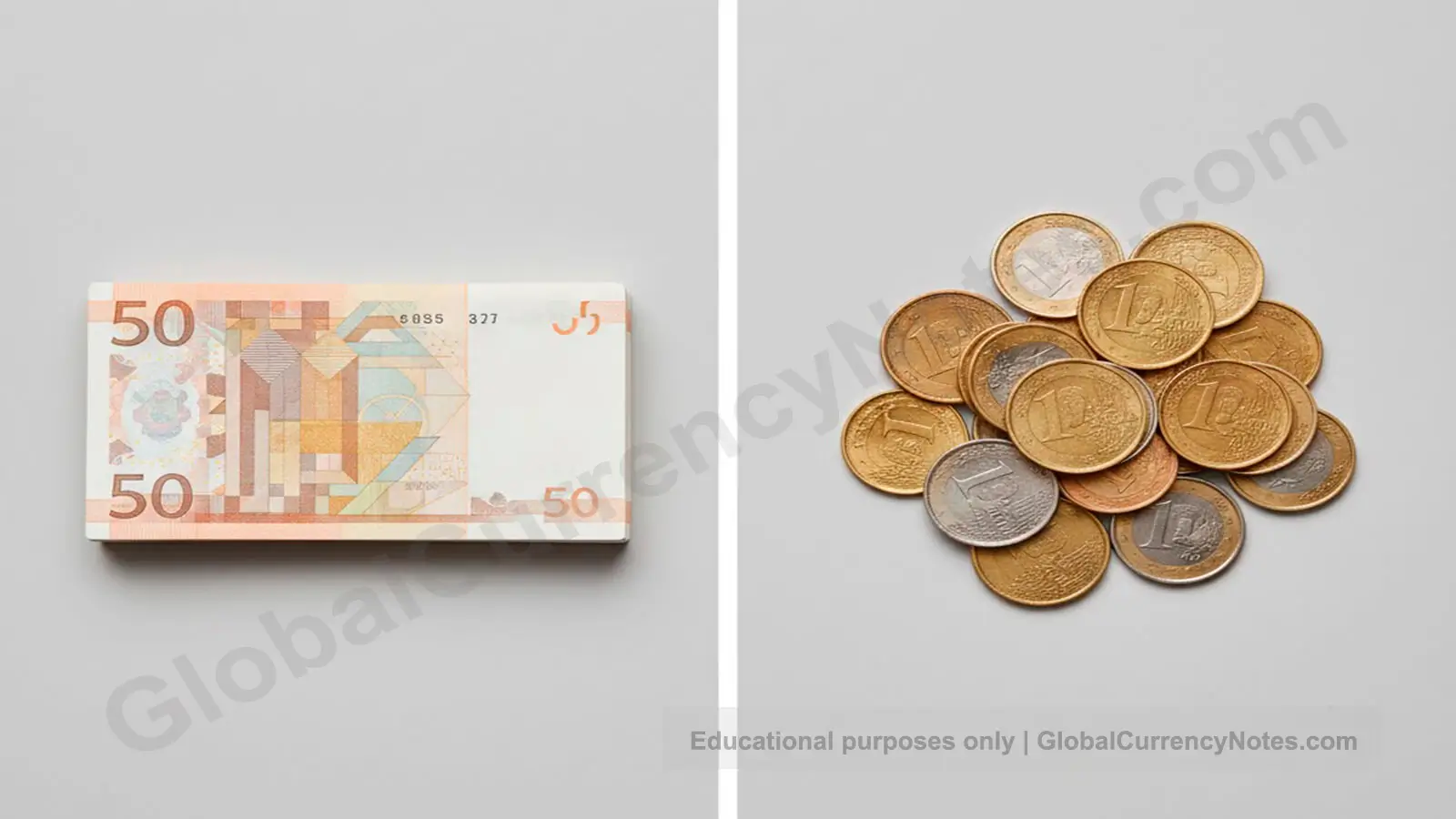
The fundamental distinction between banknotes and coins is not merely material composition—it’s the tradeoff between portability and durability. Banknotes prioritize convenience for higher-value transactions and easy transport. Coins prioritize longevity and resilience for frequent, lower-value exchanges.
Banknotes: Optimized for Convenience
- Higher denominations: Most currency systems reserve banknotes for values above the coin-note boundary (typically $1-$10 depending on the country)
- Lightweight: Based on standard note and coin weights, a thousand dollars in $20 bills would weigh approximately 50 grams, while the same value in quarters would theoretically weigh over 22 kilograms (50 pounds)
- Compact storage: Easily folded and stored in wallets or money clips
- Advanced security: Larger surface area accommodates sophisticated anti-counterfeiting features like watermarks, holograms, and color-shifting inks
- Limited lifespan: Typical circulation life ranges from approximately 4-7 years for paper notes in many currencies, though polymer notes can last approximately 2.5-4 times longer under similar conditions
Coins: Built for Endurance
- Lower denominations: Designed for frequent, small-value transactions and making change
- Exceptional durability: Metal coins can remain in circulation for 30 years or more without significant degradation under typical usage conditions
- Tactile recognition: Distinct weight, size, and edge patterns allow identification by touch, assisting visually impaired users
- Weather resistant: Impervious to moisture, folding damage, and most forms of accidental destruction that affect paper or polymer notes
- Heavy and bulky: Based on standard coin weights, carrying $100 in quarters (400 coins) would weigh approximately 2.27 kilograms (5 pounds)
Material Composition and Production
The materials used to manufacture banknotes and coins reflect their intended purposes and typical circulation lifespans.
Banknote Materials
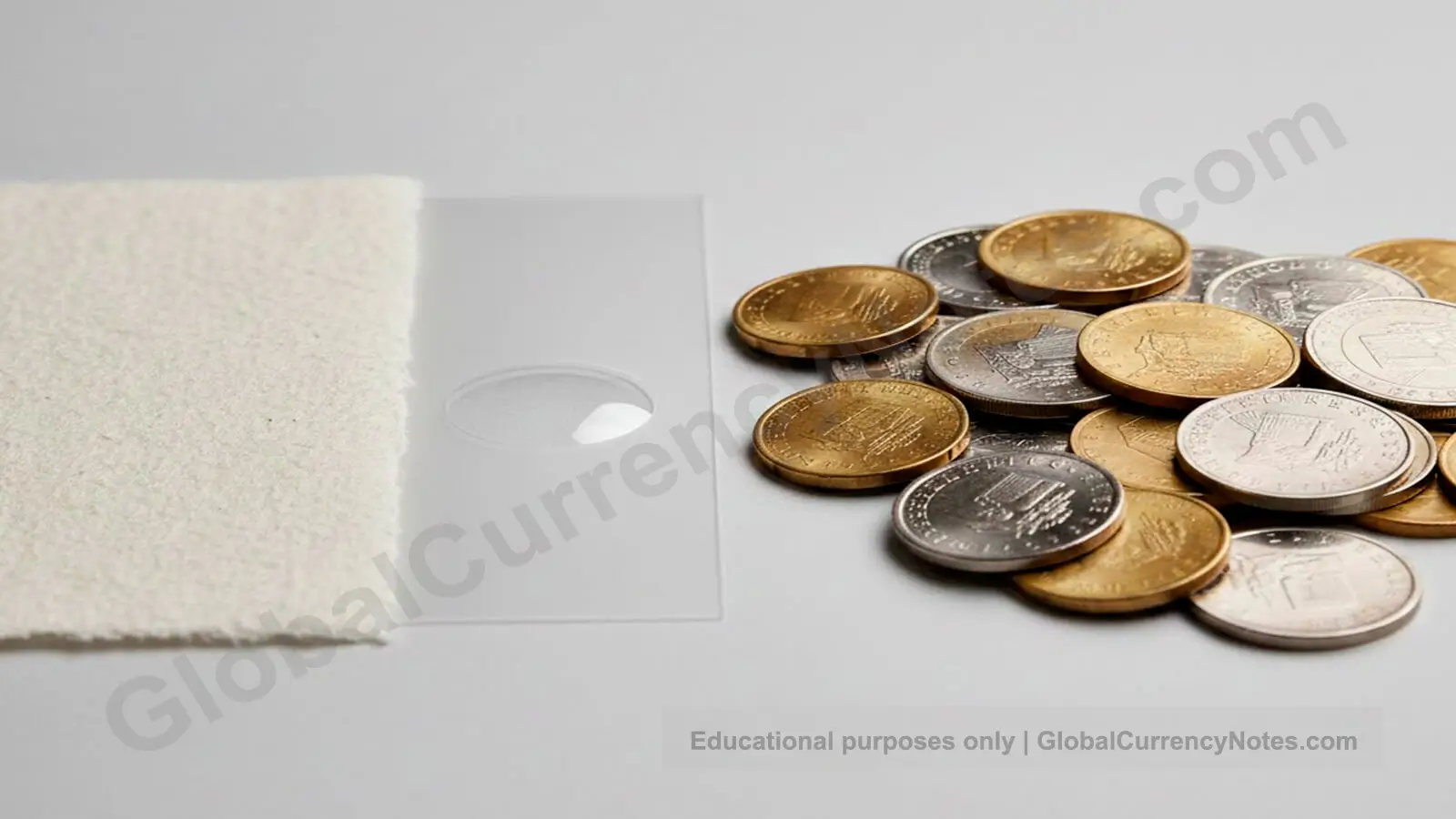
Traditional banknotes are made from specialized cotton-linen paper. United States currency, for example, uses a blend of 75% cotton and 25% linen—not wood pulp paper. This composition provides superior strength and a distinctive texture.
Polymer banknotes, introduced by Australia in 1988 and now adopted by many countries worldwide, use biaxially-oriented polypropylene (BOPP). This plastic substrate offers significant durability advantages, typically lasting approximately 2.5 to 4 times longer than equivalent paper notes under similar circulation conditions, though actual performance varies.
For detailed comparison of paper and polymer banknotes, see: Paper vs Polymer Banknotes: Key Differences Explained.
Coin Materials
Modern circulating coins are typically made from base metal alloys rather than precious metals. Common compositions include:
- Copper-nickel alloys: Used in many quarter and higher-value coins (e.g., U.S. quarters are approximately 91.67% copper, 8.33% nickel)
- Zinc core with copper plating: U.S. pennies minted after 1982 are approximately 97.5% zinc with 2.5% copper coating, reducing production costs
- Brass and bronze: Common in euro cent coins and many other currency systems
- Bi-metallic construction: Some higher-denomination coins (like the €1 and €2) use two different metal alloys for enhanced security and distinctive appearance
Historically, coins contained precious metals (gold, silver) with face values corresponding to metal content. Today, coins are fiat currency—their value derives from government decree rather than intrinsic metal worth.
Durability and Circulation Lifespan
The stark difference in material durability has profound implications for currency management and replacement costs.
Coin Longevity
Coins can circulate for 30 years or more before wear renders them unsuitable for continued use, though actual lifespan varies by denomination, usage intensity, and circulation conditions. Their metal construction resists the physical stresses of daily handling—folding, moisture exposure, and abrasion—that quickly degrade paper currency. This exceptional longevity can make coins economically advantageous for frequently-used denominations despite higher initial production costs.
Banknote Lifespan
Paper banknotes typically remain in circulation for shorter periods, though specific lifespans vary significantly by denomination and circulation intensity:
- Lower-denomination paper notes: Approximately 1-7 years in many currencies (actual lifespan depends on usage frequency)
- Higher-denomination paper notes: Approximately 7-24 years in some currencies due to less frequent circulation
- Polymer notes: Approximately 7-16+ years depending on denomination in countries using polymer substrates, significantly extending usable life compared to paper
The frequent replacement requirement for paper notes creates ongoing production and distribution costs that central banks must manage continuously.
For more details, see: How Long Do Banknotes Last? Lifespan, Wear, and Replacement.
Production Costs and Economic Considerations
While coins have higher upfront manufacturing costs, their extended lifespan can make them more economical for low-denomination currency over time.
Coin Production Economics
According to recent U.S. Mint data, producing a penny has been reported to cost approximately 3.7 cents—significantly more than its face value—though production costs fluctuate with metal prices and manufacturing conditions. A nickel has been reported to cost approximately 10.4 cents to manufacture under recent conditions. These upside-down economics persist because removing these denominations would require restructuring the entire pricing system, and coins’ 30+ year lifespan means they can generate value over time despite initial production losses. Specific production costs vary by period and economic conditions.
Banknote Production Economics
Banknotes are generally cheaper to produce per unit but require frequent replacement. Bureau of Engraving and Printing reports have indicated that producing a U.S. dollar note costs approximately 7.5 to 16 cents depending on denomination and complexity of security features, though costs vary by time period and production volume. Because notes must be replaced every few years, lifetime production costs can potentially exceed those of equivalent-value coins over extended periods.
The Note-Coin Boundary: Why Some Values Work Better as Metal
Every currency system faces a critical decision: at what denomination should coins transition to banknotes? This «note-coin boundary» varies by country and reflects complex economic and practical considerations.
Attempts to Shift the Boundary
The United States has repeatedly attempted to introduce $1 coins (Susan B. Anthony dollar in 1979, Sacagawea dollar in 2000, Presidential dollars in 2007) to replace the $1 note, which has had a relatively short reported lifespan. These attempts generally failed to gain widespread public acceptance despite potential government savings estimates.
Success stories exist elsewhere: Canada eliminated the $1 note in 1989, introducing the «loonie» coin. The United Kingdom uses £1 and £2 coins. The Eurozone employs €1 and €2 coins. These countries demonstrate that higher-value coins can succeed when governments commit to complete note withdrawal rather than allowing notes and coins to compete.
Factors Influencing the Boundary
- Purchasing power: As inflation erodes currency value, what was once a «high» denomination becomes more commonly used, potentially favoring the durability of coins
- Cultural habits: Public resistance to change can override economic considerations
- Vending machine infrastructure: Existing automated systems designed for specific denominations resist change
- Transaction patterns: Countries with frequent small-value transactions may benefit more from coin durability
Security Features and Counterfeiting Resistance
Banknotes typically incorporate more sophisticated anti-counterfeiting technologies than coins due to their larger surface area and higher denomination values.
Banknote Security
Modern banknotes employ multiple security layers that are difficult or impossible to implement on coins:
- Watermarks: Embedded images visible when held to light
- Security threads: Embedded strips with microprinting and fluorescent properties
- Color-shifting ink: Pigments that change color when viewed from different angles
- Holograms and diffractive features: Optical elements that create movement effects
- Ultraviolet features: Elements visible only under UV light
- Tactile features: Raised printing detectable by touch, also aiding visually impaired users
For comprehensive coverage, see: Banknote Security Features Explained.
Coin Security
Coins rely on different security approaches:
- Precise weight and dimensions: Difficult to replicate exactly without specialized equipment
- Edge patterns: Reeded (grooved), smooth, or lettered edges that are challenging to counterfeit
- Bi-metallic construction: Two-metal coins are extremely difficult to duplicate accurately
- Microtext and detailed engraving: Fine details that require sophisticated minting technology
- Electromagnetic properties: Vending machines and automated systems test coins using magnetic and electrical properties unique to genuine coins
Despite these features, coins are generally more difficult to counterfeit profitably than banknotes simply because their face value is typically low relative to the cost of producing convincing fakes.
Everyday Usage Patterns and Behavioral Economics
How people interact with banknotes versus coins in daily life differs significantly, potentially affecting spending behavior and cash management.
The «Pain of Holding» Phenomenon
Some behavioral economics research has suggested a «pain of holding» effect—the idea that people may experience psychological discomfort carrying coins compared to banknotes, even when the monetary value is identical. This potential discomfort could stem from coins being:
- Heavier and more cumbersome
- Awkwardly stored in pockets or purses where they jangle and accumulate randomly
- Difficult to count quickly without separating by denomination
Some studies have indicated this may lead certain individuals to spend coins more readily than equivalent amounts in banknotes, though spending behavior varies significantly by individual, culture, and circumstance. The extent and universality of this effect remain subjects of ongoing research.
Storage and Organization
Wallets and cash management systems typically treat banknotes and coins differently:
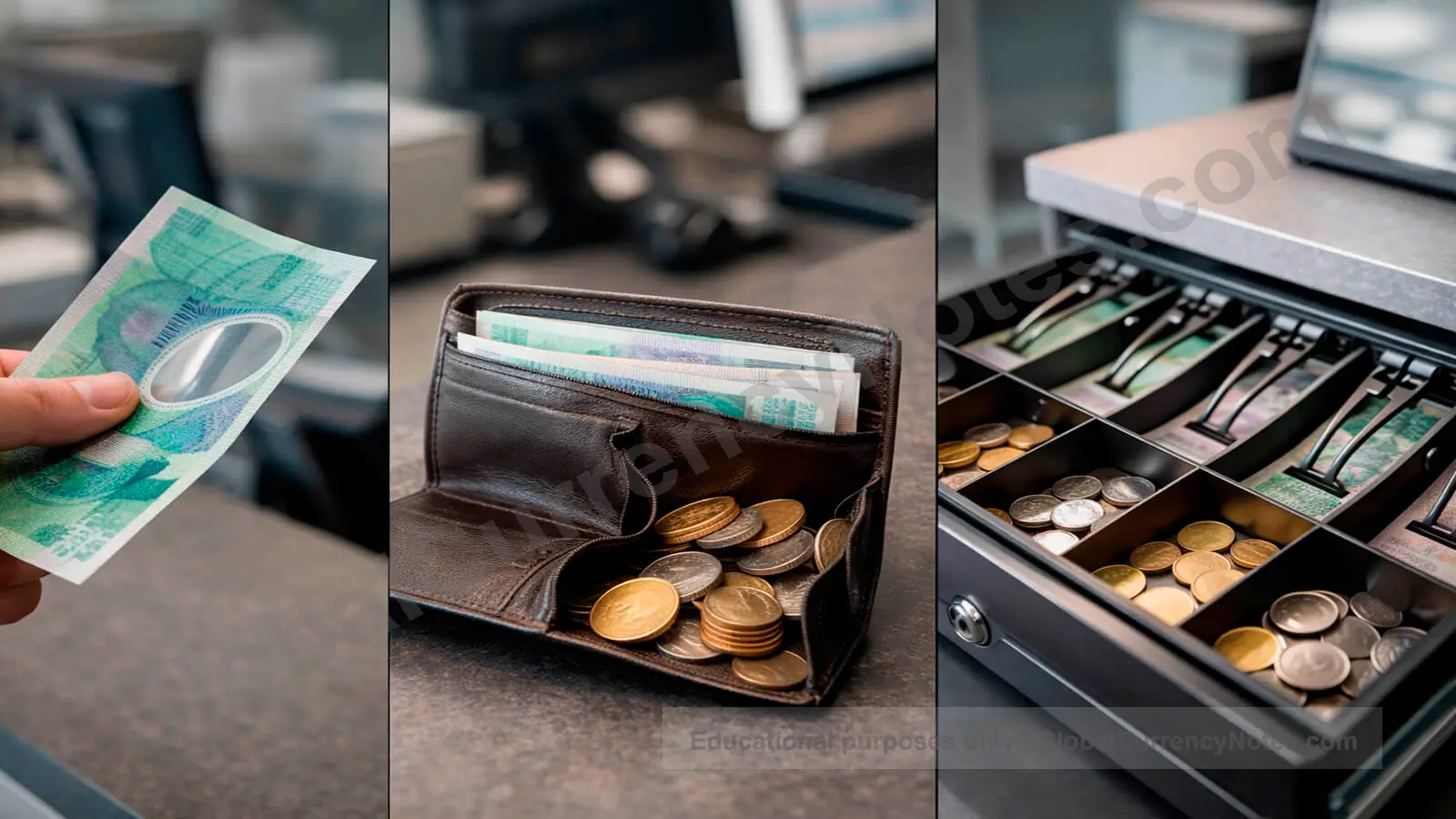
- Banknotes: Stored flat in dedicated compartments, easily organized by denomination, quickly counted
- Coins: Typically kept in separate coin purses, accumulate in pockets or jars at home, often perceived as less valuable despite representing the same purchasing power
Business Handling
Retail cash registers generally organize currency by type:
- Notes: Stored in large compartments sorted by denomination, easy to grasp and count
- Coins: Stored in smaller compartments or coin trays, requiring more manual dexterity to handle and dispense
Accessibility and Inclusive Design
Physical currency design must accommodate users with varying abilities, particularly visual impairments.
Tactile Recognition
Coins have inherent advantages for visually impaired users:
- Distinct sizes allow denomination identification by touch
- Weight differences provide additional identification cues
- Edge patterns (smooth, reeded, or shaped) offer tactile differentiation
Banknotes increasingly incorporate accessibility features:
- Varying sizes by denomination (common in Euro, British Pound, and many other currencies)
- Raised tactile marks indicating value (implemented in many modern currency series)
- High-contrast colors and large numerals
- Distinct textures created through intaglio printing
However, some currency systems have historically used uniform note sizes, making denomination identification challenging for visually impaired users—a design limitation that is gradually being addressed in various countries.
Environmental Impact and Sustainability
The environmental footprints of banknotes and coins differ significantly across their lifecycles.
Resource Consumption
- Banknotes: Can require cotton farming (paper notes) or petroleum-based polymers, manufacturing processes that typically use water, and frequent replacement cycles that multiply environmental impact over time
- Coins: Metal mining and smelting are generally energy-intensive, but coins’ 30+ year lifespan means this environmental cost is amortized over decades
Transportation and Distribution
Coins’ weight creates higher transportation energy costs. Based on standard weights, a million dollars in quarters would weigh approximately 22,680 kilograms (50,000 pounds), requiring heavy-duty armored vehicles and consuming significant fuel. The same value in $100 bills would weigh approximately 10 kilograms (22 pounds), dramatically reducing transportation environmental impact.
Recycling and End-of-Life
- Worn coins: Can be melted and refined, with metal entering general metal recycling streams or being reused for new coin production
- Worn banknotes: Paper notes can be shredded and converted to compost, insulation, or energy through incineration; polymer notes are increasingly recycled into plastic products like building materials or agricultural applications
Which Is «Better»—Banknotes or Coins?
Neither form of currency is universally superior. Each serves distinct economic functions, and optimal currency systems strategically deploy both:
When Banknotes Excel
- Carrying larger amounts of money ($50+ in most economies)
- International travel where weight and bulk matter
- Situations requiring rapid counting or verification
- Implementing sophisticated anti-counterfeiting technologies
When Coins Excel
- Small-value transactions requiring change-making (under $5 in most economies)
- High-frequency, small-denomination transactions (vending machines, parking meters, public transit)
- Environments where currency faces moisture, rough handling, or long-term storage without careful maintenance
- Supporting accessibility for visually impaired users through tactile recognition
Frequently Asked Questions
Why don’t all countries use the same denominations for coins vs banknotes?
The coin-note boundary depends on factors unique to each economy: inflation rates, average transaction values, cultural preferences, existing infrastructure (vending machines, ATMs), and government cost-benefit analyses. What works as a coin in one country might function better as a note elsewhere based on these local conditions. Denomination policies vary significantly by country.
If coins last 30 years and notes last only 4-7 years, why not make everything out of metal?
Higher denominations as coins would be impractically heavy and bulky. Based on standard coin weights, carrying $500 in $1 coins would weigh over 11 kilograms (25 pounds), making everyday commerce unmanageable. The weight-to-value ratio makes coins unsuitable for amounts people regularly need to transport.
Are polymer banknotes replacing paper everywhere?
Not universally. Many countries worldwide—estimated at 50 or more—have adopted polymer for at least some denominations due to durability and security advantages. However, many countries retain paper notes due to established production infrastructure, lower upfront costs, cultural preferences, or concerns about polymer’s environmental impact. Adoption varies significantly by country and region.
Can coins and notes have the same denomination value?
Yes, though it’s generally avoided in modern currency systems. The United States has both $1 coins and $1 notes in simultaneous circulation, though the coins see limited use. Most currency authorities prefer clear denomination separation to avoid public confusion and help ensure efficient circulation.
Why does producing a penny cost more than it’s worth?
Rising metal prices (zinc, copper) and manufacturing costs have made penny production economically challenging. However, eliminating pennies would require repricing goods and services, updating automated systems, and overcoming public attachment to traditional denominations. Some countries (Canada, Australia) have eliminated low-value coins through cash payment rounding. Specific production costs vary with metal prices and manufacturing conditions.
Which has better security against counterfeiting?
Banknotes can incorporate more sophisticated anti-counterfeiting features due to their larger surface area and advanced printing technologies. However, coins are generally less profitable to counterfeit because their typically low face values don’t justify the specialized equipment needed to produce convincing fakes. Both forms use complementary security approaches appropriate to their format.
Do people really spend coins faster than banknotes of the same value?
Some behavioral economics research has suggested that certain individuals may experience psychological discomfort («pain of holding») from carrying coins compared to equivalent value in banknotes, potentially leading to faster spending. However, spending behavior varies significantly by individual, culture, and circumstance. The extent and universality of this effect remain subjects of ongoing research.
Disclaimer: Information provided is for educational purposes only and does not constitute professional advice. Banknote standards and regulations vary by jurisdiction and are subject to change. Readers should exercise their own judgment. For full legal disclosures and liability limitations, visit our Legal Notice.