Part of: Banknote Authentication
This article is part of the Banknote Authentication hub, covering methods and technologies used to verify genuine banknotes and detect counterfeits.
UV and IR banknote authentication represent critical verification methods that reveal hidden security features invisible to the naked eye. Ultraviolet (UV) and infrared (IR) detection provide Level 2 security verification essential for businesses, financial institutions, and high-volume cash handlers facing elevated counterfeit risk.
Understanding how UV and IR authentication works, what security features these technologies reveal, and when to employ them can help businesses make informed decisions about counterfeit protection while recognizing both the capabilities and limitations of these detection methods. The European Central Bank and U.S. Currency Education Program provide official guidance on authentication technologies.
Why UV and IR Authentication Matters
Sophisticated counterfeiters can sometimes replicate visible security features with reasonable accuracy using advanced printing equipment. However, accurately reproducing UV-fluorescent materials and IR-responsive inks typically requires specialized knowledge, expensive materials, and production capabilities that can be challenging for many counterfeiting operations to access.
Central banks deliberately incorporate UV and IR features as «escalation barriers»—security elements that can dramatically increase counterfeiting difficulty without requiring the public to use specialized equipment for basic authentication. These features serve dual purposes: they’re accessible to businesses with inexpensive detection tools while simultaneously enabling automated machine verification in high-speed cash processing systems.
Industry reports have suggested that businesses using UV detection alongside manual checks can significantly reduce counterfeit acceptance rates, with some studies indicating reductions of 85-90% or more compared to visual inspection alone, though actual effectiveness varies by counterfeit sophistication, operator training, implementation quality, and verification thoroughness. When UV and IR detection are combined with other verification methods in controlled conditions, some estimates suggest detection rates can approach very high levels, though real-world performance varies based on multiple factors.
Ultraviolet (UV) Authentication: Revealing the Invisible
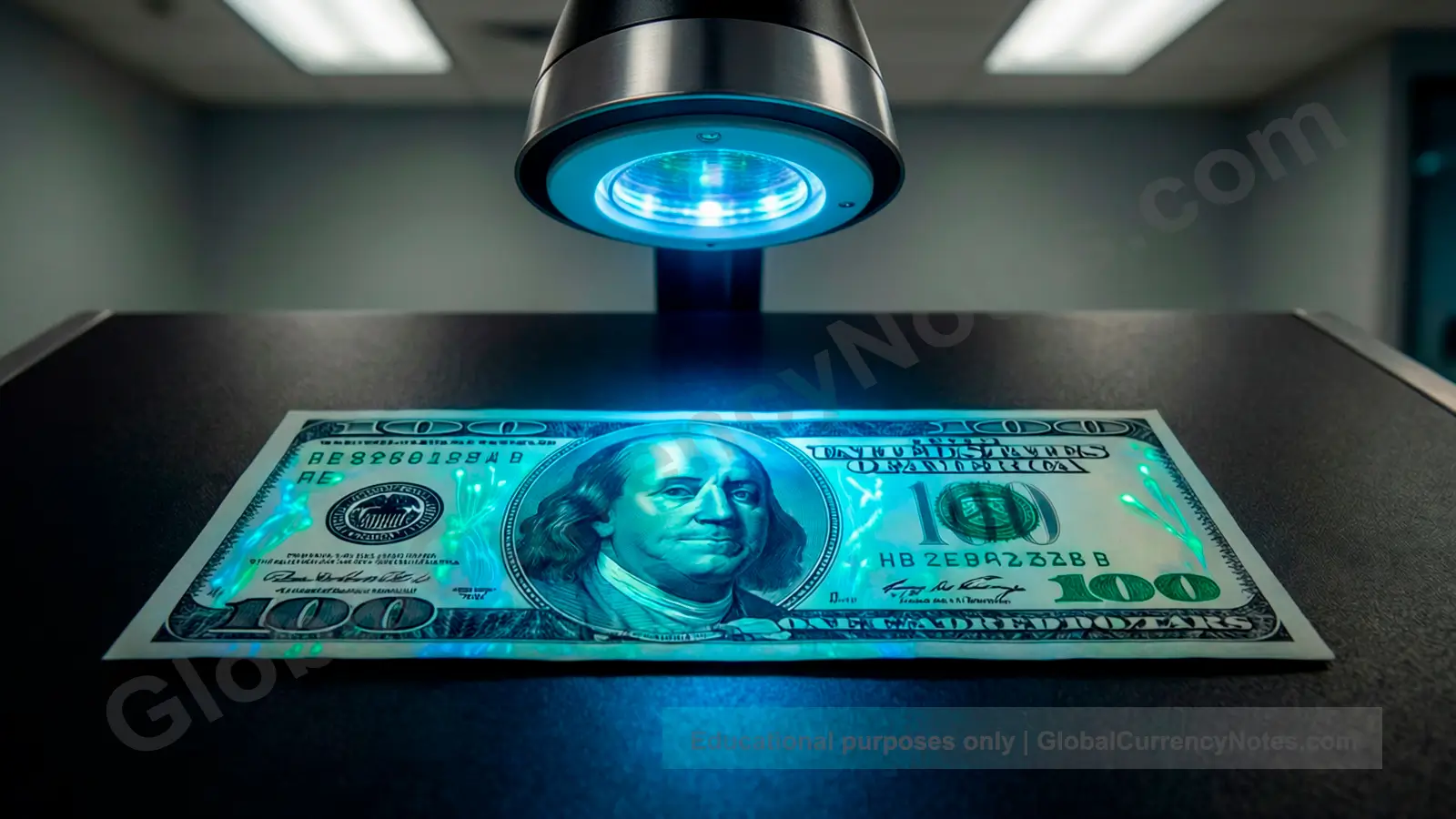
UV authentication exploits a fundamental property of certain materials: they absorb ultraviolet light and re-emit energy at visible wavelengths, creating fluorescence. Genuine banknotes typically incorporate UV-reactive features that glow distinctively under ultraviolet illumination, while ordinary paper and many counterfeit attempts may show no fluorescence or display incorrect patterns.
The Science of UV Fluorescence
Ultraviolet light exists just beyond the violet end of the visible spectrum, with wavelengths between approximately 10 and 400 nanometers. Banknote authentication typically uses UV-A light at approximately 365 nanometers—a wavelength that can efficiently excite fluorescent phosphors while remaining generally safe for operators with normal precautions.
When UV light strikes fluorescent materials embedded in genuine banknotes, these materials absorb the high-energy ultraviolet photons and re-emit lower-energy photons in the visible spectrum. This process—called fluorescence—creates the characteristic glow visible when authentic currency is examined under UV light. The fluorescent glow typically appears green, yellow, orange, or red depending on the specific phosphor compounds used.
UV Security Features in Genuine Banknotes
Central banks typically incorporate multiple UV-reactive elements into currency designs:
- Fluorescent fibers: Tiny thread-like fibers distributed randomly throughout the banknote paper. These fibers—typically colored red, blue, or green—are generally invisible in normal light but glow brightly under UV illumination. Some counterfeiters attempt to print simulated fibers on the surface, but these typically lack the random three-dimensional distribution of genuine embedded fibers
- Invisible UV patterns: Specific designs, serial numbers, or symbols printed with inks containing UV-fluorescent phosphors. These marks are typically invisible in daylight but appear vividly under UV light. Different currencies use distinctive UV patterns—for example, euro banknotes display architectural elements and stars that glow under UV, while U.S. currency shows denomination information and security thread features
- Security threads: Embedded strips running vertically through notes that often contain UV-reactive materials. When illuminated with UV light, these threads typically display text, denomination values, or repeating patterns in fluorescent colors
- Denomination-specific features: Each note value within a currency series typically has unique UV characteristics. For example, different euro denominations display distinct UV patterns, allowing rapid denomination verification alongside authenticity checking
What Genuine Banknote Paper Does Under UV Light
An important anti-counterfeiting principle: genuine currency paper—whether cotton-linen blend or polymer—is specially manufactured to remain dull or non-fluorescent under UV light. This dark background can make fluorescent security features stand out dramatically.
Ordinary paper often contains optical brighteners added during manufacturing to make paper appear whiter. These brighteners typically fluoresce brightly under UV light, causing the entire paper to glow blue-white. This property can create an immediate visual distinction: when placing a genuine banknote and ordinary paper side-by-side under UV light—the genuine note generally stays dark with specific features glowing, while ordinary paper may glow uniformly.
Counterfeiters working with commercial-grade paper face a challenge: they can either print on ordinary bright paper (potentially immediately detectable under UV) or attempt to chemically treat paper to suppress fluorescence (expensive, inconsistent, and still often distinguishable from genuine currency paper).
Practical UV Authentication Process
Using UV detection typically follows this sequence:
- Place the banknote under a UV lamp emitting light at approximately 365 nanometers
- Verify that the paper substrate remains dull/dark (not glowing uniformly)
- Identify expected fluorescent features—security threads, fibers, invisible patterns—that should glow in specific colors and locations
- Compare observed UV response against reference materials or memory of genuine notes
This process typically takes approximately 2-5 seconds per note once operators are familiar with the expected UV appearance of their currency. Compact UV lamps designed for currency verification typically cost in the range of approximately $20-$100, though prices vary by model, quality, and retailer, making UV detection one of the most cost-effective counterfeit prevention methods available.
Infrared (IR) Authentication: Machine-Readable Security
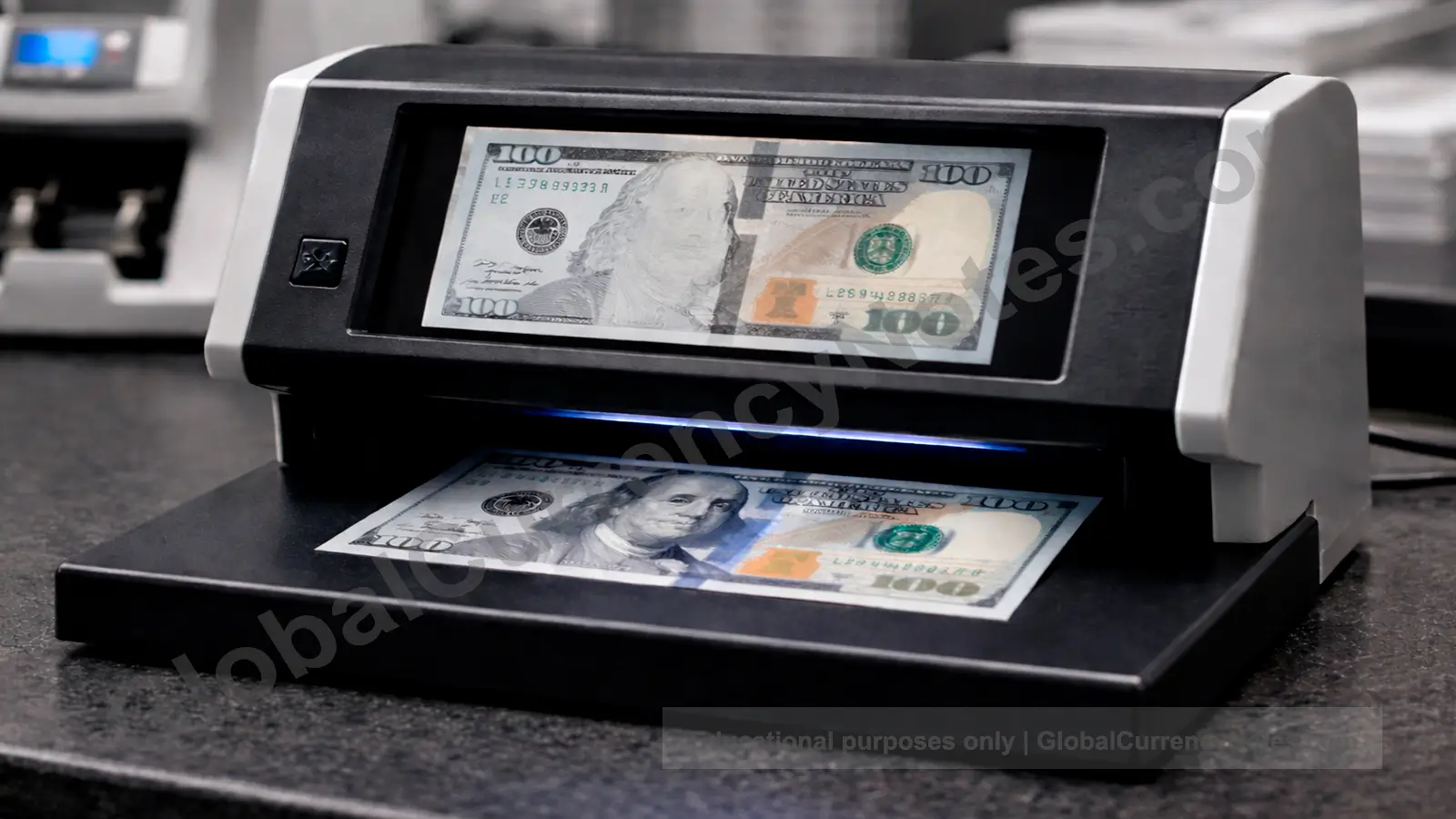
Infrared authentication analyzes how banknote inks and materials respond to infrared light—electromagnetic radiation with wavelengths longer than visible light (approximately 700-1000 nanometers for currency authentication applications). Unlike UV detection, which is designed for human operators to visually verify, IR authentication primarily serves automated machine verification, though manual IR viewers exist.
How IR-Responsive Inks Work
Central banks print banknotes using specialized inks that typically exhibit specific behaviors under infrared illumination. These inks generally fall into two categories:
- IR-absorbing inks: These inks contain pigments that absorb infrared wavelengths strongly, appearing black or very dark when viewed through IR sensors or cameras. On genuine banknotes, specific design elements—often denomination numerals, borders, or particular patterns—are typically printed with IR-absorbing ink
- IR-reflecting inks: These inks reflect infrared light, appearing bright or glowing when viewed through IR detection equipment. Other portions of the note design may use these reflective inks, creating high-contrast patterns under IR illumination that differ dramatically from their visible-light appearance
The strategic combination of IR-absorbing and IR-reflecting inks can create unique patterns invisible to the naked eye but clearly distinguishable to IR sensors. These patterns serve as «machine-readable codes» that automated validators use to rapidly authenticate notes and determine denominations.
Why IR Is Primarily Machine-Readable
IR authentication faces a significant practical limitation for human operators: the patterns are often complex and denomination-specific, requiring operators to memorize how each note type should appear under IR light.
For example, genuine U.S. currency displays denomination-specific IR patterns—different notes show different band configurations and positions. Expecting busy retail cashiers to remember these intricate, denomination-specific patterns for every currency they handle can be impractical.
Consequently, IR detection is most effective in automated systems:
- Vending machines and slot machines that need to identify note denominations rapidly
- High-speed bill validators used in retail point-of-sale systems
- Bank note counting and sorting machines processing thousands of notes per hour
- ATM note acceptors verifying deposited currency
These automated systems use IR sensors strategically positioned to detect specific patterns, comparing real-time readings against stored reference data for each supported currency and denomination. Authentication decisions typically occur in milliseconds, with machines rejecting notes that fail IR pattern verification.
Manual IR Inspection Tools
Despite the complexity, manual IR viewers exist for businesses that want to supplement UV detection. These handheld devices display banknotes through an IR-sensitive viewfinder or screen, allowing operators to visually inspect IR patterns.
However, effective manual IR verification typically requires:
- Training staff to recognize expected IR patterns for commonly handled denominations
- Maintaining reference materials showing genuine IR appearances
- Understanding that IR features are designed primarily for machine reading, making human interpretation less intuitive than UV verification
Manual IR viewers generally range from approximately $100-$500, though costs vary significantly by features, quality, and manufacturer.
UV vs IR Authentication: Complementary Technologies
UV and IR detection serve different but complementary roles in comprehensive counterfeit prevention strategies:
Ultraviolet Authentication
- Target users: Retailers, small businesses, bank tellers, individual consumers
- Verification method: Human visual inspection
- Speed: Approximately 2-5 seconds per note
- Primary features detected: Fluorescent fibers, UV patterns, security threads, paper substrate properties
- Equipment cost: Approximately $20-$100 for basic UV lamps (prices vary)
- Strengths: Generally intuitive, fast, inexpensive, relatively easy to train operators
- Limitations: Requires operator attention and basic training; may not detect all sophisticated counterfeits
Infrared Authentication
- Target users: Automated validation systems, specialized cash processors, forensic laboratories
- Verification method: Automated sensor analysis (primarily)
- Speed: Milliseconds (automated); approximately 5-10 seconds (manual inspection)
- Primary features detected: IR-absorbing/reflecting ink patterns, machine-readable codes
- Equipment cost: Approximately $100-$500 for manual viewers; approximately $500-$5,000+ for automated validators (prices vary significantly)
- Strengths: Highly reliable when automated; can be difficult for counterfeiters to replicate correctly
- Limitations: Complex for human operators; requires more expensive equipment; patterns vary by denomination
Combining UV/IR with Other Detection Methods
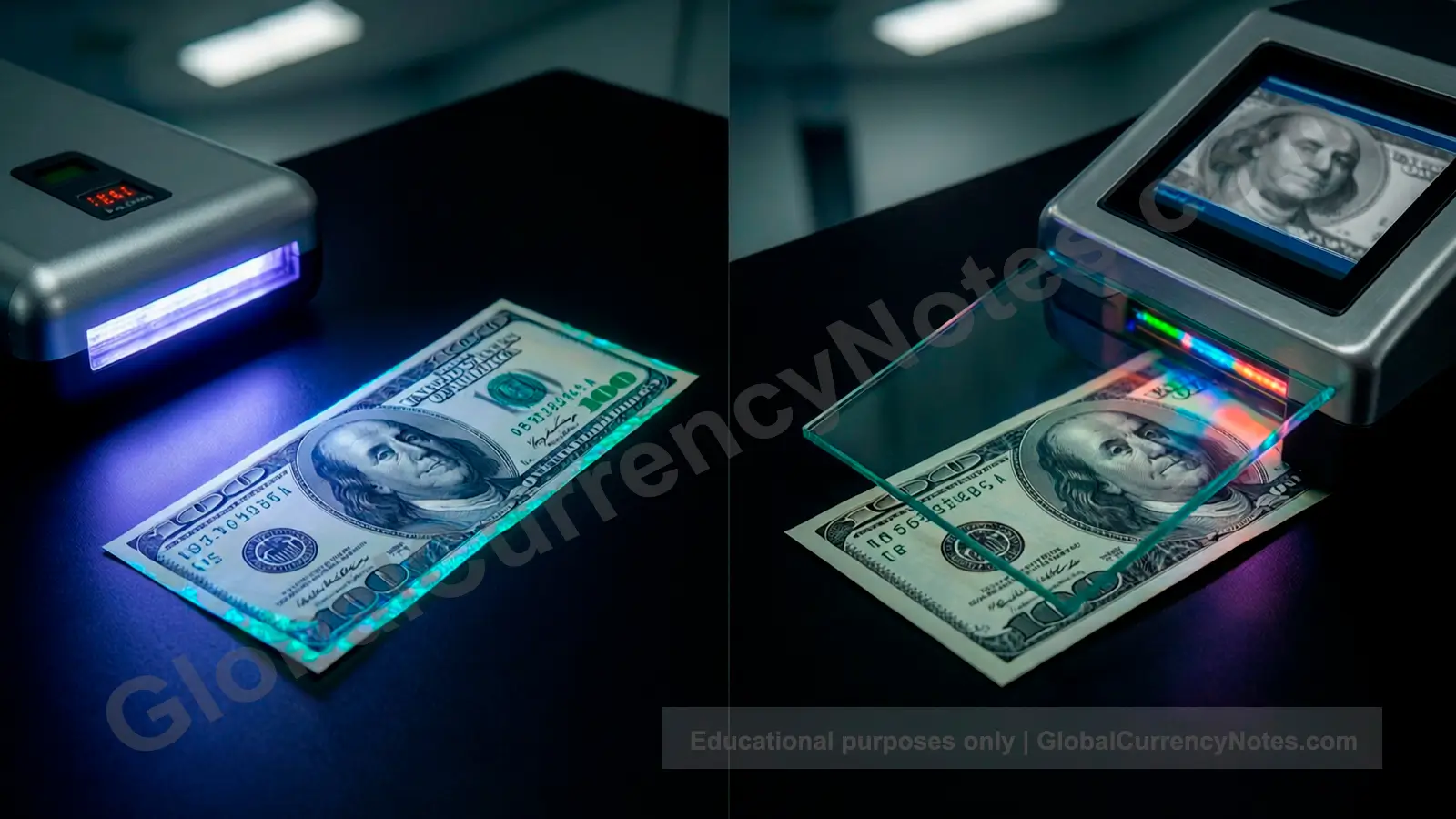
Neither UV nor IR authentication provides 100% detection accuracy when used in isolation. Sophisticated counterfeiters with access to specialized resources may potentially create notes that pass some single-method tests, though such operations are less common. Maximum protection typically requires layered verification:
The Multi-Method Approach
- Start with Feel-Look-Tilt (Level 1): Quick manual check of texture, watermarks, and color-shifting features—typically takes approximately 1-2 seconds
- Add UV verification (Level 2): For higher-value notes or suspicious currency—typically adds approximately 2-5 seconds
- Use automated multi-feature validators (Level 2+): For high-volume operations—tests UV, IR, magnetic properties, and dimensions simultaneously, typically in under 1 second
- Reserve expert examination (Level 3): For definitively questionable notes—submit to central bank or forensic specialists
When to Escalate Verification Methods
Practical guidelines for businesses (adapt based on local currency and risk assessment):
- Lower denominations: Feel-Look-Tilt typically sufficient for most situations
- Medium denominations: Feel-Look-Tilt plus UV check often recommended
- Higher denominations: Multi-method verification (manual + UV + automated validator if available) generally advisable
- Unfamiliar or foreign currency: Enhanced verification typically recommended
- Suspicious appearance or context: Maximum available verification methods
Limitations and Realistic Expectations
While UV and IR detection can significantly improve counterfeit detection rates, users must understand their limitations:
What UV/IR Cannot Guarantee
- 100% certainty: Sophisticated counterfeiters with access to specialized materials may create notes that pass basic UV/IR tests, though such operations are less common. No authentication method provides absolute certainty
- Detection of all fraud types: «Washed» bills (genuine low-denomination notes bleached and reprinted as higher values) may pass some UV tests if original paper is used
- Identification of worn genuine notes: Heavily circulated authentic banknotes may show degraded UV features, potentially triggering false rejections in automated systems or raising suspicion during manual inspection
- Replacement of operator judgment: UV/IR tools assist verification but don’t eliminate the need for trained, attentive staff and proper procedures
- Universal applicability: UV/IR features vary by currency, denomination, and series—training and reference materials must be currency-specific
Best Practices for Effective UV/IR Use
- Train staff on what genuine UV/IR patterns look like for commonly handled currencies
- Keep UV lamps clean (contamination can reduce effectiveness)
- Replace UV bulbs according to manufacturer schedules (output can degrade over time)
- Maintain reference materials showing expected UV/IR appearances
- Never rely solely on UV or IR—always combine with other verification methods
- Update knowledge when new banknote series are introduced with changed UV/IR features
- Understand that equipment effectiveness depends on proper use, maintenance, and operator training
The Future of UV/IR Authentication
As smartphone cameras and sensors improve, mobile UV/IR authentication may become increasingly feasible. Some research prototypes have demonstrated smartphone-based fluorescence detection using LED flash modules modified to emit UV wavelengths. Future developments may bring UV/IR verification capabilities to consumer devices, further democratizing advanced authentication methods, though practical implementation challenges remain.
Additionally, central banks continue advancing UV/IR features. Recent innovations include:
- Multi-wavelength fluorescence (requiring different UV wavelengths to reveal different features)
- Time-resolved fluorescence (phosphorescent materials that glow for several seconds after UV exposure ends)
- Metameric inks (appearing identical in visible light but showing distinct differences under IR)
Frequently Asked Questions
Do all banknotes respond to UV light?
Most modern banknotes incorporate UV-reactive security features, though specific implementations vary significantly by country, currency, and series. Older banknote designs may lack UV features, and some lower-denomination notes use fewer UV elements than higher values. Check your currency’s official security feature documentation from your central bank for specific information.
Can I use a regular UV flashlight for banknote authentication?
While some consumer UV flashlights may work, currency authentication is typically most effective with UV lamps specifically designed to emit at approximately 365 nanometers. General-purpose UV lights may use different wavelengths that don’t optimally excite banknote fluorescent materials. Effectiveness varies by light source quality and specifications.
Why doesn’t my genuine banknote show the expected UV features?
Heavily worn genuine banknotes may show degraded UV features due to circulation damage. Additionally, exposure to certain chemicals, cleaning agents, or prolonged washing machine cycles can diminish fluorescence. If uncertain about a note’s authenticity, submit questionable notes to your bank for verification according to local procedures.
Can counterfeiters replicate UV features?
Adding some UV response is possible using commercially available fluorescent materials. However, accurately replicating the specific fluorescent colors, patterns, precise locations, and substrate properties of genuine currency typically requires specialized materials and knowledge. Many counterfeits either show no UV response or display incorrect fluorescence patterns, though sophisticated counterfeits may attempt to replicate UV features with varying degrees of success.
Is IR authentication better than UV?
Neither is universally «better»—they serve different purposes and contexts. UV is generally more practical for human operators and business use. IR is typically superior for automated machine verification. Maximum security generally comes from combining both methods with other verification techniques. The optimal approach depends on your specific needs, volume, and risk profile.
How do automated validators use UV and IR together?
High-end validators typically illuminate notes with both UV and IR light while simultaneously using sensors to detect magnetic properties and measure physical dimensions. Algorithms analyze all readings collectively, requiring notes to pass all tests. This multi-sensor approach can achieve very high detection accuracy in controlled conditions, though actual performance varies by device quality, maintenance, and counterfeit sophistication.
Do polymer banknotes have different UV/IR features than paper notes?
Yes. Polymer substrates themselves typically don’t fluoresce under UV (similar to cotton-linen paper), but polymer notes often use different UV-reactive elements than paper notes—for example, UV-visible features within transparent windows. IR characteristics may also differ due to different ink formulations compatible with polymer substrates. Specific features vary by currency and series.
Disclaimer: Information provided is for educational purposes only and does not constitute professional advice. Banknote standards and regulations vary by jurisdiction and are subject to change. Readers should exercise their own judgment. For full legal disclosures and liability limitations, visit our Legal Notice.