Part of: Banknote Security
Comprehensive guide to British pound sterling polymer banknotes, security features, authentication methods, and Bank of England currency specifications.
British pound banknotes are among the most secure polymer currencies in circulation globally. According to the Bank of England, all four current denominations feature advanced authentication elements including transparent windows, color-shifting holograms, and tactile features designed to make counterfeiting challenging while maintaining accessibility for verification.
With counterfeiting rates that remain among the lowest internationally according to Bank of England reporting, pound sterling demonstrates how modern security design can support public confidence while maintaining practical usability for everyday transactions.
This guide explains the security features, authentication methods, and characteristics of British pound banknotes currently in circulation based on publicly available Bank of England information.
Current Denominations and Specifications
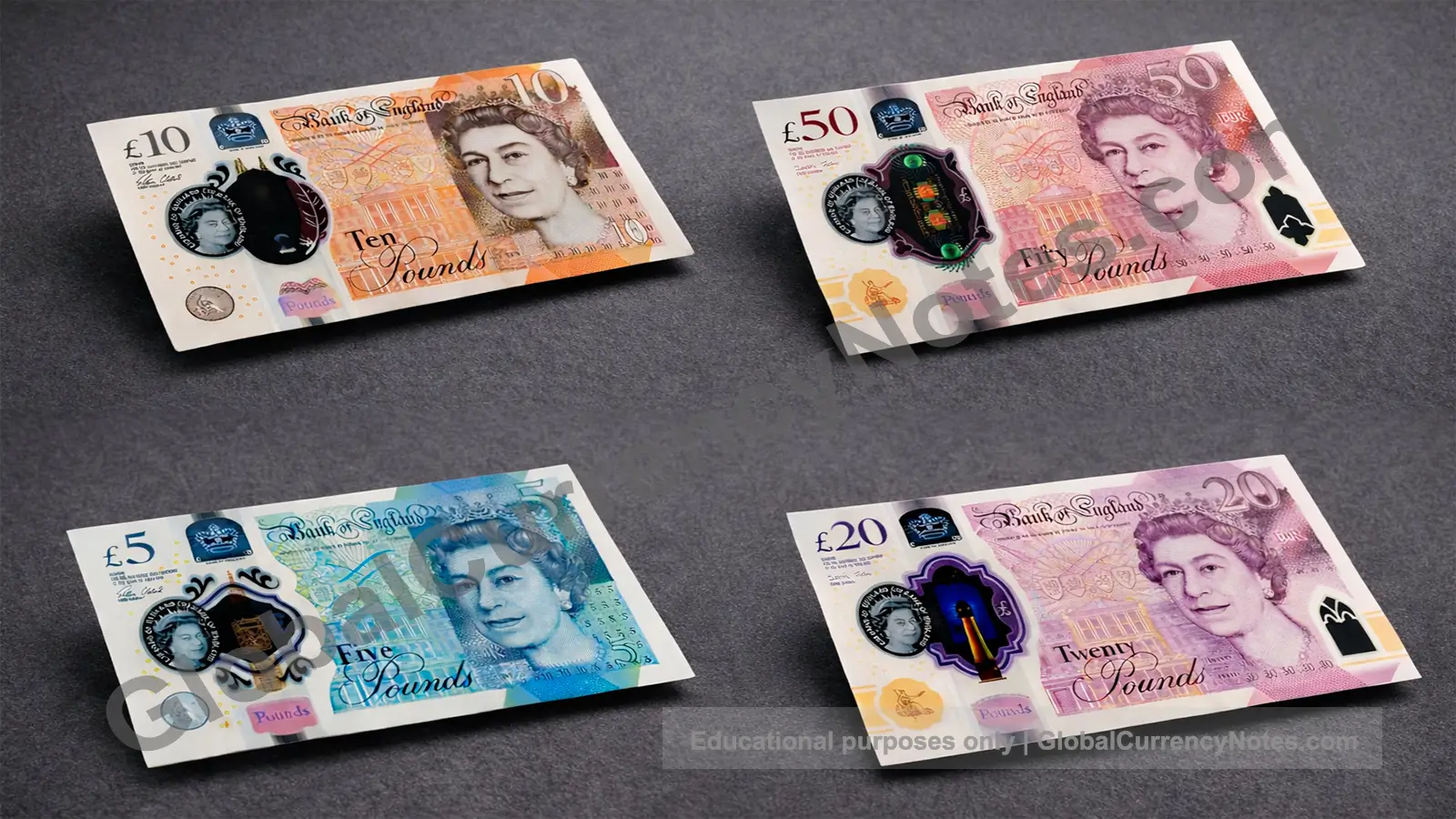
The Bank of England issues four polymer banknote denominations. Each differs in size, color, and featured historical figure, making them distinguishable in daily use.
Size and Color Differences
According to Bank of England specifications, banknote dimensions increase progressively with value. This graduated sizing helps visually impaired users identify denominations through physical measurement.
Color coding provides additional recognition: turquoise for £5, orange for £10, purple for £20, and red for £50. These distinct hues are designed to remain distinguishable even under varied lighting conditions.
Featured Figures
Each denomination celebrates a notable British historical figure. The £5 honors Winston Churchill, the £10 features Jane Austen, the £20 displays J.M.W. Turner, and the £50 recognizes Alan Turing and his contributions to computer science and mathematics.
The Polymer Transition
Between 2016 and 2021, the Bank of England replaced traditional paper banknotes with polymer versions. According to Bank of England reports, this transition aimed to improve durability and security while potentially reducing environmental impact through extended circulation life.
The rollout occurred gradually by denomination starting in 2016. Since completion of the transition, polymer notes have circulated throughout the United Kingdom with values representing a substantial portion of the monetary system.
According to Bank of England data, polymer banknotes are designed to last significantly longer than paper equivalents under normal circulation conditions. They resist moisture, dirt, and certain types of damage better than traditional paper currency, though actual lifespan varies based on denomination usage patterns and handling conditions.
King Charles III Banknotes
In 2024, the Bank of England introduced banknotes featuring King Charles III. According to Bank of England announcements, these notes retain existing security features while updating the monarch’s portrait on both sides of each denomination.
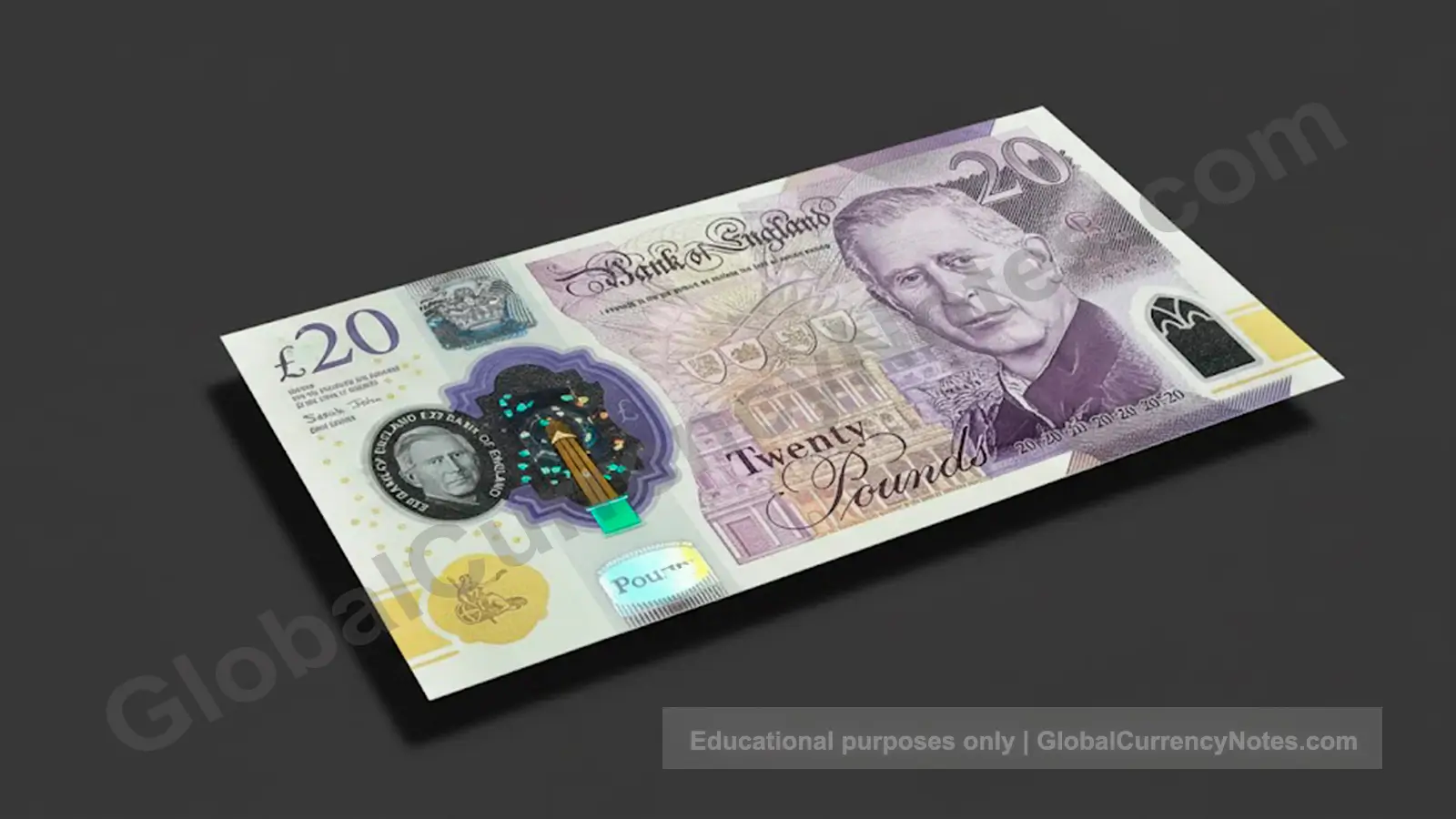
Both Elizabeth II and Charles III versions remain legal tender according to current Bank of England policy. The Bank follows a practice of replacing notes through natural circulation wear rather than mass exchange programs, allowing both designs to co-circulate.
The transition occurs gradually as worn notes are removed from circulation and replaced, an approach designed to minimize waste and operational costs while avoiding public inconvenience.
Core Security Features
British pound banknotes incorporate multiple layers of protection. These features combine visual, tactile, and material-based authentication designed to work without specialized equipment.
Transparent Window
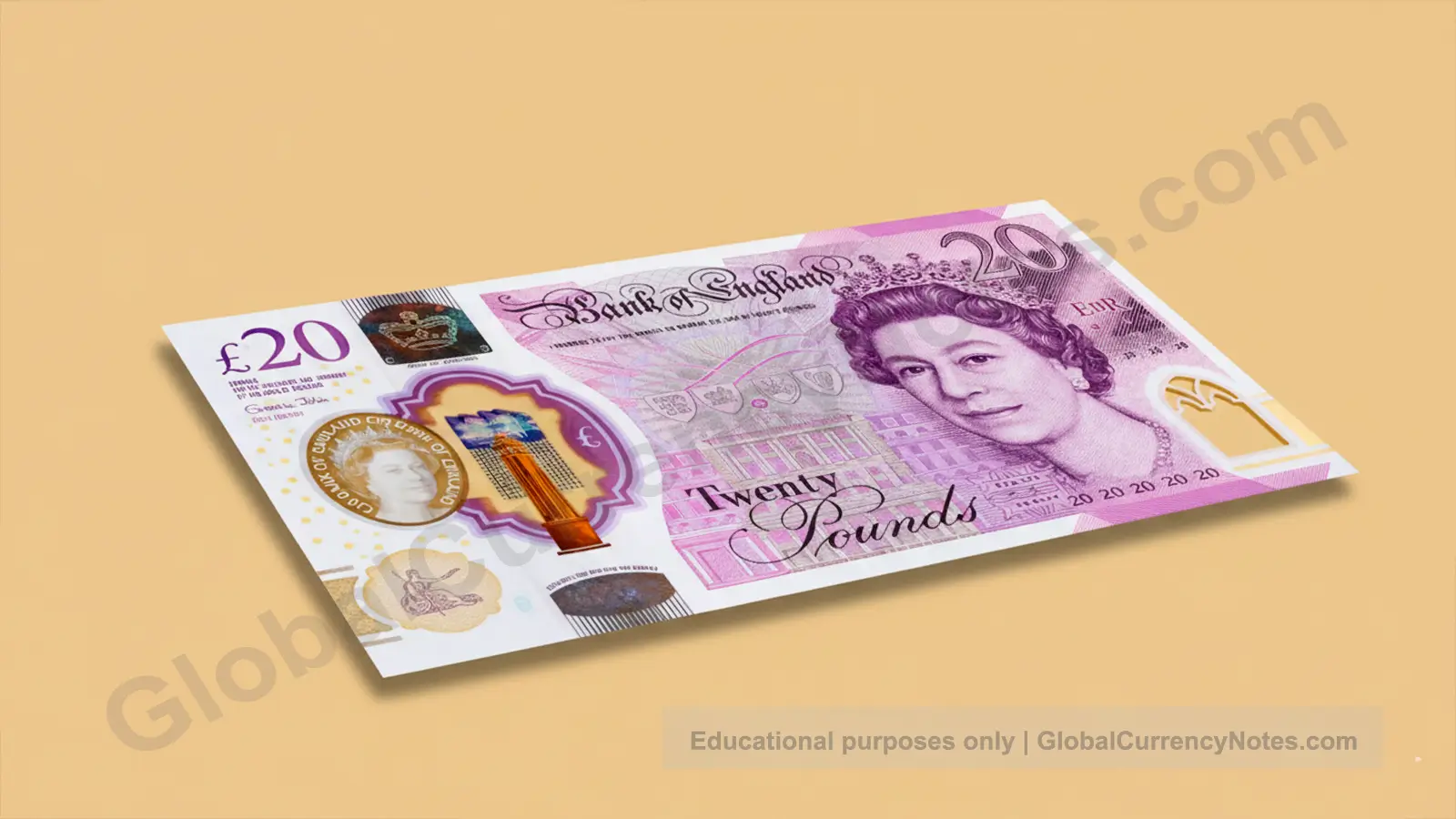
Every denomination includes a see-through polymer window containing the monarch’s portrait. This window appears transparent when held to light and demonstrates precise registration between front and back printing.
The portrait displays detail intended to be challenging to replicate convincingly in transparent substrate. The window technology represents a significant technical achievement in polymer banknote production.
Color-Shifting Hologram
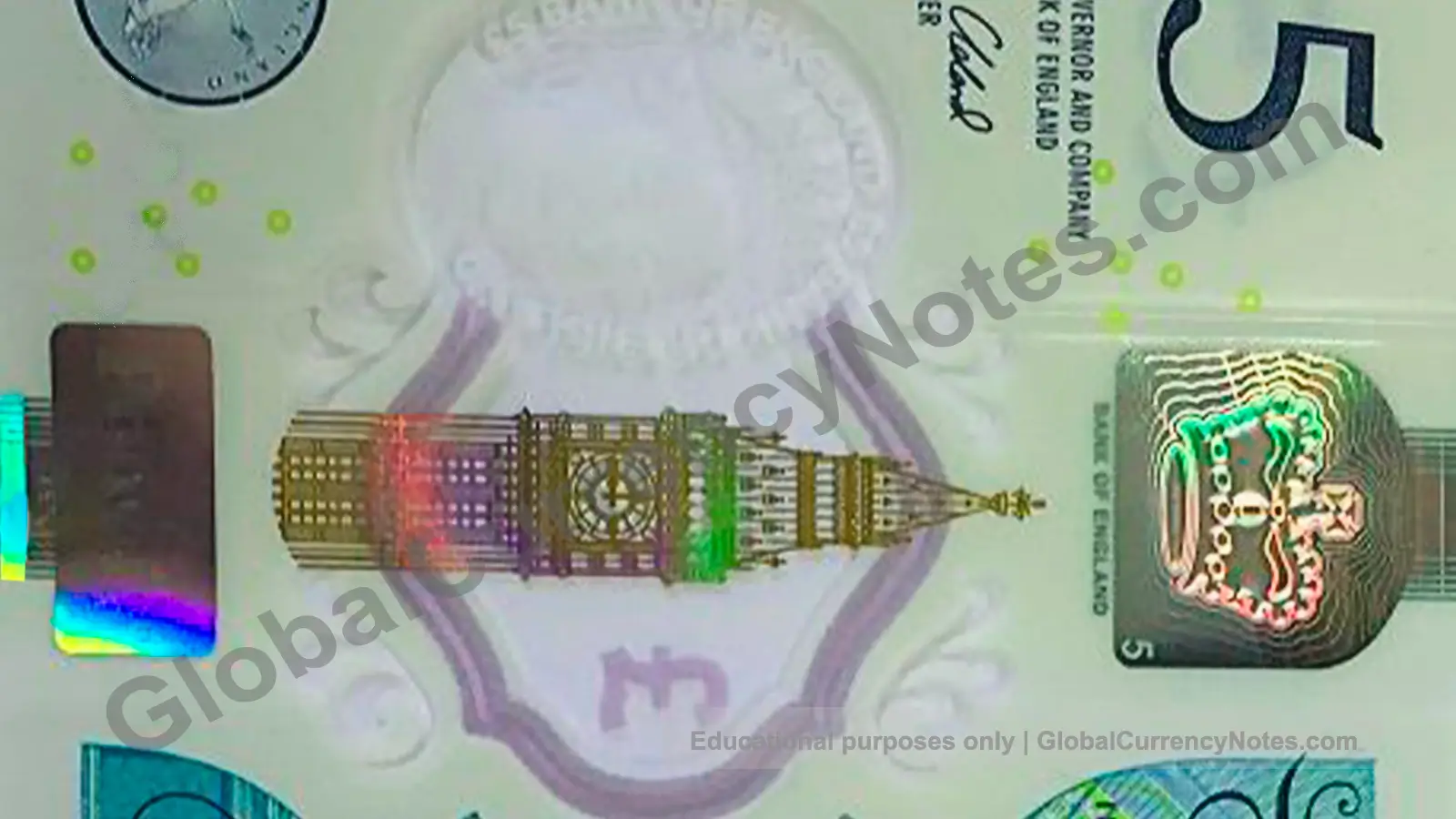
A metallic foil patch sits above the transparent window on each note. When tilted, this hologram shifts between displaying the denomination value and the word «Pounds.»
The £5 and £10 use gold foil, while the £20 combines gold and blue, and the £50 features gold and green. These color combinations provide additional denomination verification cues.
Coronation Crown
The coronation crown appears as a dimensional image visible from both sides of the transparent window. This optical element demonstrates advanced manufacturing capability designed to present significant replication challenges.
Raised Print
Intaglio printing creates raised textures on the words «Bank of England» and the numerical denomination. Running your finger across these areas reveals distinct elevation that standard printing processes cannot easily reproduce.
This tactile feature serves both security and accessibility purposes, helping visually impaired users identify genuine notes through touch.
Ultraviolet Features
Under UV light, banknotes reveal hidden elements not visible in normal conditions. The denomination value appears in fluorescent colors, while certain background areas display specific designed patterns. However, UV verification is supplementary to other authentication methods.
Counterfeit Statistics and Security Effectiveness
According to Bank of England counterfeit reporting, British pound counterfeiting rates remain low relative to total circulation volumes. The Bank publishes periodic statistics indicating that detected counterfeit rates represent a very small fraction of legitimate notes in circulation.
Bank of England data suggests that the polymer transition has contributed to reduced counterfeiting incidents compared to historical levels with paper currency. However, specific counterfeit rates vary by reporting period and detection methodology.
The £20 note historically experiences more counterfeiting attention due to its widespread use in commerce, though overall fraud levels remain low by international standards according to available comparative data.
How to Authenticate Pound Banknotes
The Bank of England recommends a straightforward verification process accessible without special equipment.
Feel the Quality
Genuine polymer notes have a distinctive smooth texture characteristic of polymer substrate. The raised print on «Bank of England» should be detectable by touch. Different materials feel noticeably different from genuine polymer.
Look at the Details
Examine the transparent window under light. The portrait should appear sharp and properly aligned on both sides. Check that the hologram shifts between value and «Pounds» when tilted.
Tilt to See Changes
The color-shifting foil provides visual confirmation. Genuine holograms display clear transitions. Counterfeit attempts may show less distinct or incomplete color changes, though verification effectiveness depends on multiple factors working together rather than any single feature.
Production and Circulation Management
British pound banknotes are manufactured under contract to the Bank of England at specialized security printing facilities equipped with polymer processing technology. Production arrangements are subject to periodic review and contractual processes.
The Bank monitors circulation levels continuously, replacing worn notes and adjusting production to match economic demand patterns. Damaged or heavily soiled notes return to the Bank for destruction and replacement according to established quality standards.
Average circulation life varies by denomination based on handling frequency. Notes used more frequently in daily transactions typically require replacement sooner than higher denominations used less often. Actual lifespan depends on many factors including usage patterns and handling conditions.
International Recognition and Exchange
British pound banknotes receive recognition internationally, though acceptance varies significantly by location and institution. Major tourist destinations and international businesses typically accept pounds, while smaller establishments may prefer local currency or widely-used reserve currencies.
Currency exchange services in most countries accept pound banknotes at prevailing rates. However, damaged, heavily worn, or older series notes may face reduced acceptance or different exchange conditions depending on institutional policies.
Legal Tender Status and Regional Variations
According to current Bank of England policy, all Bank of England polymer banknotes remain legal tender. The Bank does not set expiration dates for valid notes, and both Elizabeth II and Charles III versions maintain legal validity under current policy.
Scottish and Northern Irish banks issue their own sterling banknotes under different legal and regulatory arrangements. While these notes circulate within their issuing regions, acceptance in England and Wales may vary by merchant choice, as these notes have different legal status from Bank of England notes.
Storage and Handling Best Practices
Polymer banknotes resist water damage and certain types of tearing better than paper, but proper handling can help extend their usable life. Consider avoiding sharp folding or storage in high-heat environments, which may cause permanent creasing or substrate distortion.
Keeping notes reasonably flat in wallets or organizers when practical may help maintain condition. While polymer tolerates moisture better than paper, prolonged exposure to chemicals, oils, or extreme temperatures may potentially degrade the substrate or affect security features.
The Role of Banknote Security
Strong banknote security helps protect both individual users and the broader financial system. When counterfeiting rates remain low, public confidence in currency can remain high, potentially supporting economic stability and efficient commerce.
Security features serve multiple purposes: creating production challenges for potential counterfeiters, enabling verification without special tools, and providing forensic characteristics for law enforcement investigation when needed.
Frequently Asked Questions
Are old paper pound notes still valid?
Paper £20 and £50 notes ceased to be legal tender in September 2022 according to Bank of England announcements. However, the Bank of England accepts paper notes for exchange through postal or in-person services at their facilities. Specific procedures and requirements should be verified with the Bank of England directly, as policies may change.
How can I tell if a pound note is fake?
Check the transparent window for clarity and alignment, feel for raised print on «Bank of England,» and tilt to observe the hologram shift between value and «Pounds.» Genuine notes display these features clearly, though no single feature provides certainty without examining multiple elements together. When in doubt, seek verification through financial institutions or authorities.
What should I do if I receive a counterfeit note?
Do not return it to the person who gave it to you, as this could create safety concerns. Contact local police and provide information about where and when you received the note. Law enforcement will follow established procedures for handling suspect currency. Specific procedures may vary by jurisdiction—always follow local guidance.
Do all UK regions use the same banknotes?
No. Scotland and Northern Ireland have their own banknotes issued by authorized commercial banks under different regulatory frameworks. These notes are legal currency but have different legal tender status than Bank of England notes in England and Wales. Acceptance varies by merchant choice. For detailed information about regional currency, consult the relevant issuing banks or the Bank of England.
Can I exchange damaged pound notes?
The Bank of England operates procedures for damaged currency assessment. Damaged notes can be submitted with required documentation, and the Bank assesses whether reimbursement is appropriate based on remaining identifiable features. Specific criteria, procedures, and requirements should be verified directly with the Bank of England, as these may vary by damage type and circumstances.
Why are pound notes different sizes?
Progressive sizing helps visually impaired users identify denominations by physical dimensions. Larger denominations measure physically larger, creating a tactile identification system independent of color or printed features. This design approach supports accessibility for users with visual impairments.
How long do polymer banknotes last?
According to Bank of England information, polymer notes are designed to last significantly longer than paper equivalents under normal circulation conditions. Actual lifespan varies considerably by denomination based on usage frequency and handling conditions. Lower denominations used frequently in daily transactions typically require replacement sooner than higher denominations. Specific lifespan estimates vary based on circulation patterns and are subject to ongoing monitoring.
Disclaimer: Information provided is for educational purposes only and does not constitute professional advice. Banknote standards and regulations vary by jurisdiction and are subject to change. Readers should exercise their own judgment. For full legal disclosures and liability limitations, visit our Legal Notice.