Part of: Banknote Types & Materials
Largest banknotes in the world represent remarkable examples of currency design, spanning from historical specimens that measured over a foot in length to modern high-denomination notes that continue to serve practical monetary functions while incorporating advanced security features.
Throughout history, various nations have issued exceptionally large banknotes for different purposes—some for practical economic reasons, others as commemorative pieces, and some simply as expressions of monetary sovereignty. Understanding these largest banknotes provides insight into both historical monetary systems and contemporary currency design choices.

Historical Largest Banknotes by Physical Size
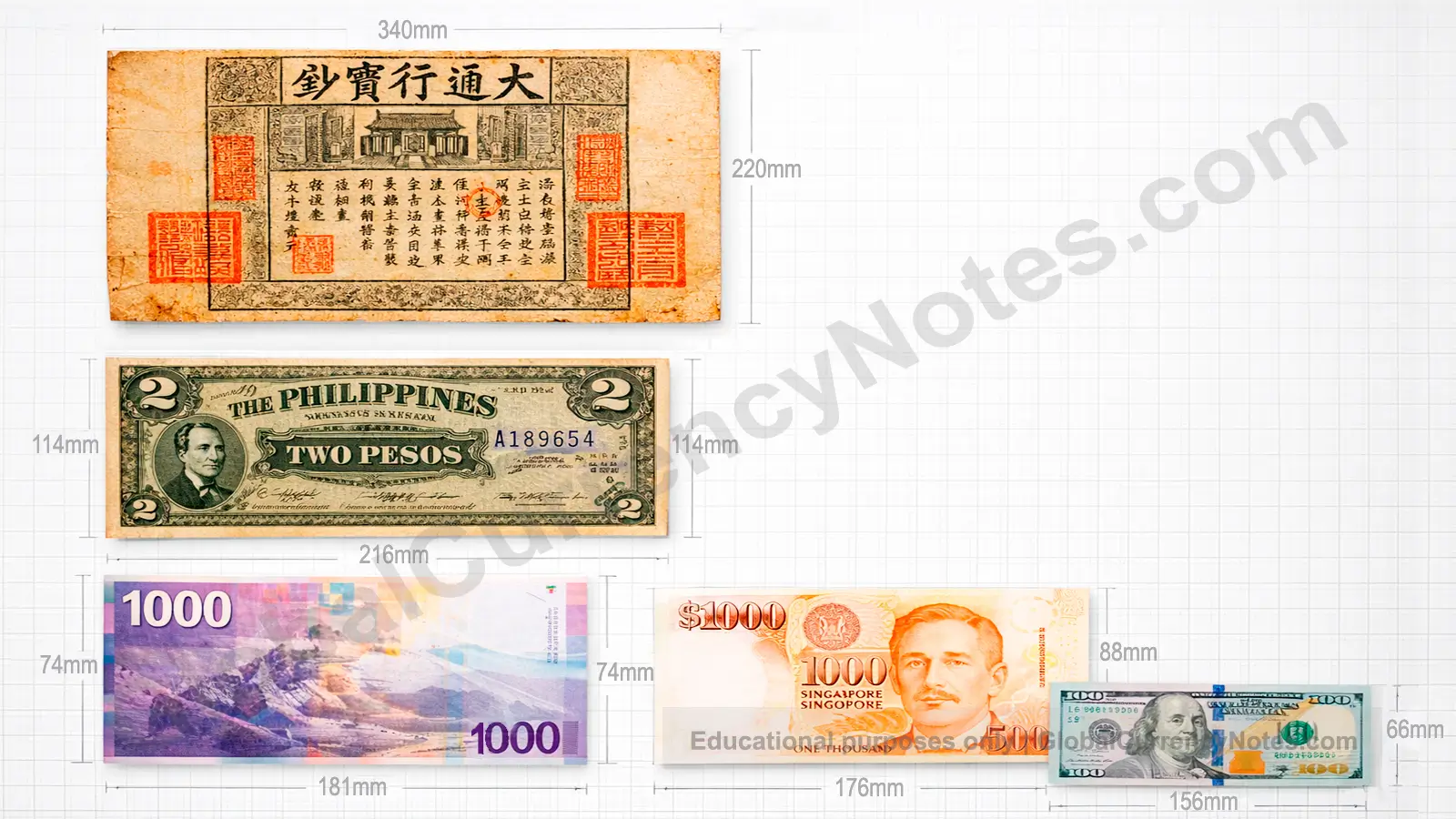
The title of physically largest banknote ever issued is often attributed to early Chinese paper currency. According to numismatic historical records, the Chinese Ming Dynasty’s «Da Ming Tong Xing Bao Chao» notes from the 14th century measured approximately 34 cm by 22 cm (roughly 13.4 by 8.7 inches), making them substantially larger than any modern currency notes in regular circulation.
In more recent history, several nations issued notably large banknotes during the late 19th and early 20th centuries. The 1918 Philippines two-peso note, produced during the American administration period, measured approximately 216 mm by 114 mm (about 8.5 by 4.5 inches), representing one of the largest banknotes of the modern era in terms of physical dimensions according to records from the Bangko Sentral ng Pilipinas.
Why Were Historical Banknotes So Large?
Several factors contributed to the substantial physical size of historical largest banknotes:
- Limited printing technology: Early printing methods made it easier to produce larger notes with visible details rather than attempting intricate work on smaller surfaces
- Security through size: Larger dimensions made counterfeiting more challenging due to the difficulty of replicating the entire note accurately with period technology
- Cultural expectations: In some societies, larger notes conveyed greater importance and authority, particularly for high-value denominations
- Visibility and handling: Before widespread literacy, larger notes allowed for more prominent visual elements that could be recognized regardless of reading ability
- Material availability: Paper production methods of earlier eras made larger sheets more economical than attempting to produce many smaller, precisely-cut notes
These historical largest banknotes served their purposes in their respective eras, though their size would be considered impractical by modern currency handling standards which prioritize automated processing and compact storage.
Largest Banknotes Currently in Circulation
Among banknotes currently in active circulation, physical dimensions have become more standardized internationally, though some notable examples of largest banknotes remain in use today:
Switzerland’s 1,000 Franc Note
The Swiss 1,000-franc note, part of the ninth series issued by the Swiss National Bank, measures 181 mm by 74 mm. While its vertical orientation creates a distinctive appearance, it represents one of the highest-value banknotes in regular circulation among major currencies and features sophisticated security elements integrated throughout its surface area.
European Union Notes
The European Central Bank’s euro banknotes follow a size-progressive system, with larger physical dimensions corresponding to higher denominations. The €500 note, though no longer produced according to ECB policy since 2019, measured 160 mm by 82 mm and remains legal tender where still in circulation, representing one of the physically larger modern banknotes by area.
Modern Practical Considerations
Contemporary largest banknotes balance multiple design requirements including fitting in standard wallets, compatibility with automated handling equipment like ATMs and currency counters, and durability considerations. Most modern banknotes have converged on dimensions roughly between 120-180 mm in length and 60-90 mm in height, representing practical compromises for banknotes that must function efficiently in modern commerce.
Largest Banknotes by Face Value
When considering «largest» by monetary face value rather than physical size, several modern and historical banknotes stand out, though exchange rates and purchasing power vary significantly over time and across economic conditions:
Current High-Denomination Notes
The Swiss 1,000-franc note represents one of the highest face values in regular circulation among major stable currencies. According to current exchange rates, this positions it as having substantial purchasing power, though exact comparative value fluctuates with currency markets. Singapore’s $1,000 note represents another example of high-denomination currency in active use.
It should be noted that nominal face value does not directly correspond to practical purchasing power or actual international worth, which varies based on exchange rates, inflation, and economic conditions. Some smaller economies issue notes with higher face values that may represent different purchasing power levels than major currency equivalents.
Historical High-Denomination Examples
Historically, periods of hyperinflation have produced some of the highest face-value banknotes ever issued. Zimbabwe’s 100 trillion dollar note from 2008-2009 represented an extreme example with an astronomical face value, though its real purchasing power was minimal during the crisis period. These examples of largest banknotes by denomination illustrate economic disruption rather than functional currency design principles.
The United States also issued high-denomination notes for inter-bank use, including $10,000 bills, though these were discontinued for general circulation and are now primarily of numismatic interest where they still exist.
Design and Production of Largest Banknotes
Modern currency design for the largest banknotes in any series must address multiple technical and practical factors:
Material and Durability
Larger physical dimensions place greater stress on banknote materials during handling. Whether produced from cotton-fiber paper or polymer substrates, the largest banknotes in a currency series typically receive additional attention to durability specifications since they often have longer circulation lifespans due to their high value and consequent lower frequency of use in typical transactions.
Security Feature Integration
Larger surface area theoretically allows for more security features, but contemporary security technology has made sophisticated protection possible even on smaller notes. Modern security design focuses on feature quality and difficulty of replication rather than quantity. The largest banknotes often serve as showcases for a nation’s most advanced currency security technologies.
Handling and Storage Infrastructure
Banking infrastructure including ATMs, currency sorting machines, and cash storage systems must accommodate the dimensions of the largest banknotes in circulation. This creates practical constraints on maximum size, as retrofitting global banking equipment would be prohibitively expensive. International standardization pressures have led to considerable convergence in banknote dimensions.

Collectible and Numismatic Aspects
Historical examples of largest banknotes often carry numismatic value beyond their face value, particularly rare specimens in well-preserved condition. However, collectible value depends on numerous factors including rarity, historical significance, condition grade, provenance, and current market demand among specialized collectors.
The market for collectible banknotes, particularly historical large-format notes, can be specialized and sometimes illiquid compared to more mainstream collectibles. Authentication by reputable grading services is strongly advisable for any significant purchases, as counterfeits of valuable historical notes exist in the market.
Claimed values for rare historical largest banknotes can vary substantially between sources and actual transaction prices may differ significantly from published price guides depending on market conditions and specific characteristics of individual specimens.
Why Physical Size Matters Less Today
Several technological and economic developments have reduced the importance of physical size for largest banknotes:
- Advanced security technologies: Modern features like holograms, color-shifting inks, and microprinting provide sophisticated protection without requiring large dimensions
- Digital payment systems: Electronic transactions handle large-value transfers more efficiently than physical currency, reducing the practical need for very high-denomination physical notes
- Automated handling: Modern banking relies heavily on machines that process currency, creating standardization pressure toward dimensions compatible with international equipment
- Counterfeiting evolution: Modern counterfeiting techniques make feature sophistication more important than size for security purposes
These factors explain why contemporary largest banknotes rarely approach the physical dimensions of historical examples, even when face values are substantially higher in real terms.
Frequently Asked Questions About Largest Banknotes
What is the physically largest banknote ever made?
According to historical numismatic records, the Chinese Ming Dynasty’s «Da Ming Tong Xing Bao Chao» notes from the 14th century are often cited as among the physically largest banknotes ever officially issued, measuring approximately 34 cm by 22 cm. Among more modern examples, the 1918 Philippines two-peso note at roughly 216 mm by 114 mm represents one of the largest banknotes of the 20th century in terms of physical dimensions.
What is the highest denomination banknote currently in circulation?
Among major stable currencies in active regular circulation, the Swiss 1,000-franc note represents one of the highest face values, though purchasing power equivalents vary based on exchange rates. Singapore also issues $1,000 notes for general circulation. Some countries maintain even higher denominations for specialized use, though these may have limited practical circulation.
Why don’t countries make larger physical banknotes anymore?
Modern banking infrastructure, including ATMs and automated currency handling equipment, creates practical constraints on maximum dimensions. Additionally, contemporary security technology makes sophisticated protection possible on smaller notes, eliminating the historical security advantage of large physical size. International commerce benefits from standardization, creating pressure toward compatible dimensions across currencies.
Are old large banknotes still legal tender?
This depends entirely on the specific banknote and the policies of its issuing authority. Most historical banknotes are no longer legal tender and retain only collectible value. Some central banks maintain redemption programs for older series with specific timeframes and conditions. Current legal tender status should always be verified with the relevant monetary authority before attempting to use historical notes for transactions.
Do largest banknotes have better security features?
Not necessarily. While larger surface area provides more space for security elements, modern security technology has made physical size less critical for protection. Many contemporary smaller banknotes incorporate security features that exceed the protection offered by older, physically larger notes. Security effectiveness depends primarily on technology sophistication rather than dimensions.
Why did some countries stop issuing their largest denomination notes?
Several jurisdictions have discontinued very high-denomination banknotes due to concerns about their potential use in illicit activities including money laundering and tax evasion. The European Central Bank ceased production of €500 notes in 2019, and Singapore stopped issuing new $10,000 notes, though existing notes remain legal tender. These policy decisions attempt to balance practical utility against law enforcement and regulatory concerns.
Are historical large banknotes valuable to collectors?
Some historical largest banknotes carry significant numismatic value, but this depends on multiple factors beyond just physical size, including rarity, historical significance, condition, and current market demand. Authentication and professional grading are strongly advisable for any significant collectible currency purchases. The specialized market for historical large-format notes can be illiquid, and claimed values may not reflect actual transaction prices in all cases.
Disclaimer: Information provided is for educational purposes only and does not constitute professional advice. Banknote standards and regulations vary by jurisdiction and are subject to change. Readers should exercise their own judgment. For full legal disclosures and liability limitations, visit our Legal Notice.