Part of: Banknote Security
Understanding banknote security technologies, counterfeit detection methods, and the protective features that safeguard modern currency from fraud and counterfeiting.
Most counterfeited banknotes represent specific denominations that counterfeiters target due to optimal balance between value and circulation frequency. The United States $20 bill and the Euro €20 and €50 notes consistently rank as the world’s most frequently counterfeited currency according to law enforcement statistics. These denominations offer sufficient value to justify counterfeiting effort while remaining common enough in everyday transactions that fake notes can circulate without immediately raising suspicion.
Counterfeiting patterns reflect both economic incentives and practical constraints that criminals face. High-denomination notes like $100 bills attract scrutiny during transactions, making them harder to pass successfully despite their greater value. Very low denominations offer insufficient profit margins to justify sophisticated counterfeiting operations. Mid-range denominations occupy a sweet spot where counterfeiters maximize potential profit against detection risk, explaining why $20 and €20-€50 notes dominate counterfeit statistics globally according to central bank reports.
Understanding which banknotes face the highest counterfeiting risk helps businesses, financial institutions, and individuals implement appropriate verification measures. Currency authorities continuously update security features on frequently targeted denominations, creating an ongoing technological race between legitimate issuers and criminal operations. Modern anti-counterfeiting technology has significantly reduced successful fake note circulation, though the problem persists wherever currency changes hands in high-volume retail environments.
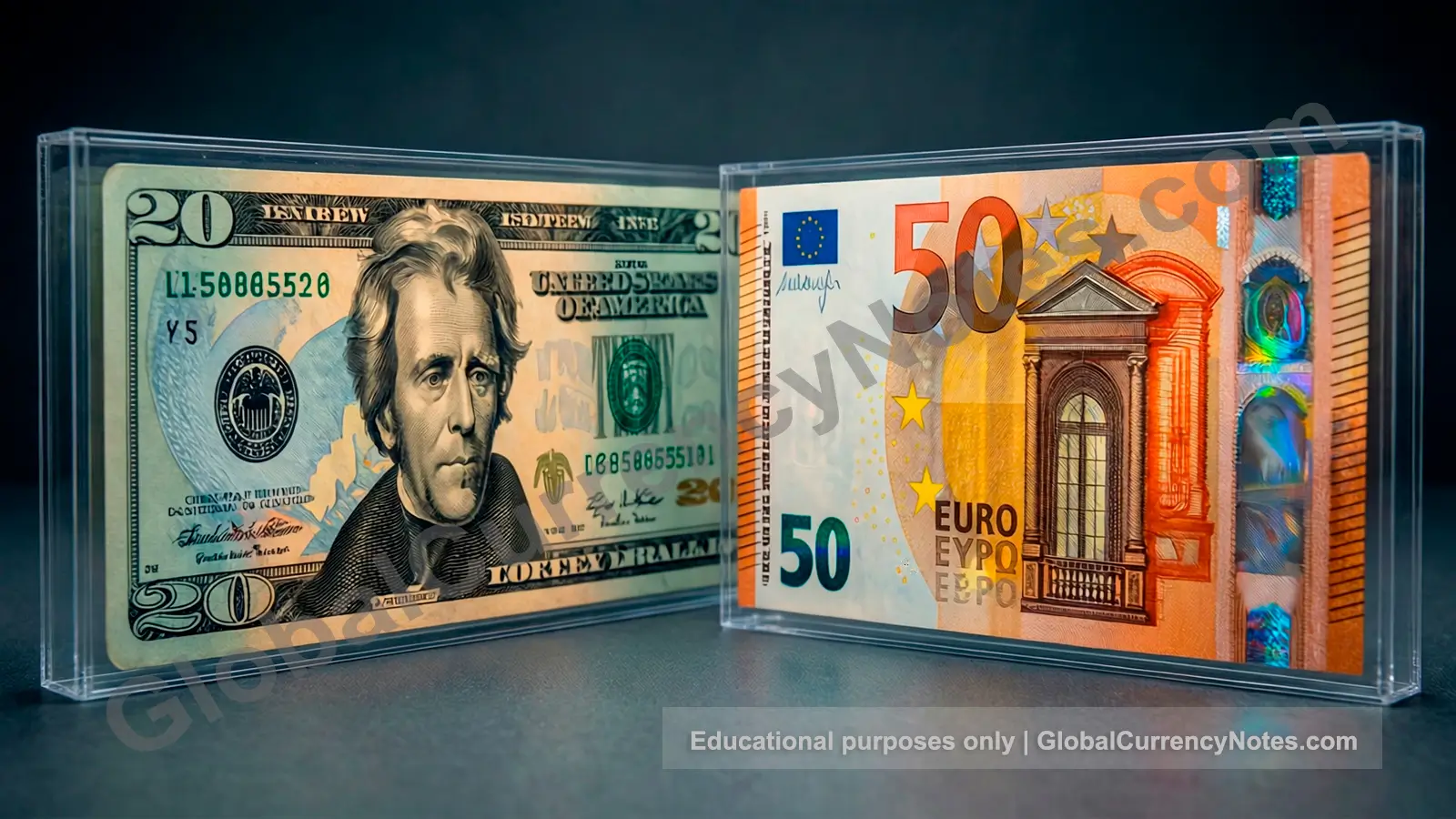
Most Counterfeited Banknotes: The US $20 Bill
The United States $20 bill accounts for approximately 70-80% of all counterfeit US currency detected domestically according to available law enforcement data. This denomination’s prevalence in everyday commerce makes it easier for counterfeiters to introduce fake notes into circulation through routine transactions at retail stores, restaurants, and service businesses. The United States Secret Service, responsible for protecting US currency, reports that despite advanced security features, the $20 remains the primary counterfeiting target among all US denominations.
Several factors explain the $20 bill’s vulnerability to counterfeiting attempts. Its widespread use means cashiers and business owners handle hundreds or thousands of these notes weekly, reducing the likelihood of careful examination for each transaction. The denomination strikes an optimal balance between value and suspicion—high enough to make counterfeiting profitable, yet common enough that presenting a $20 rarely triggers enhanced scrutiny that would accompany larger bills like $50 or $100 denominations.
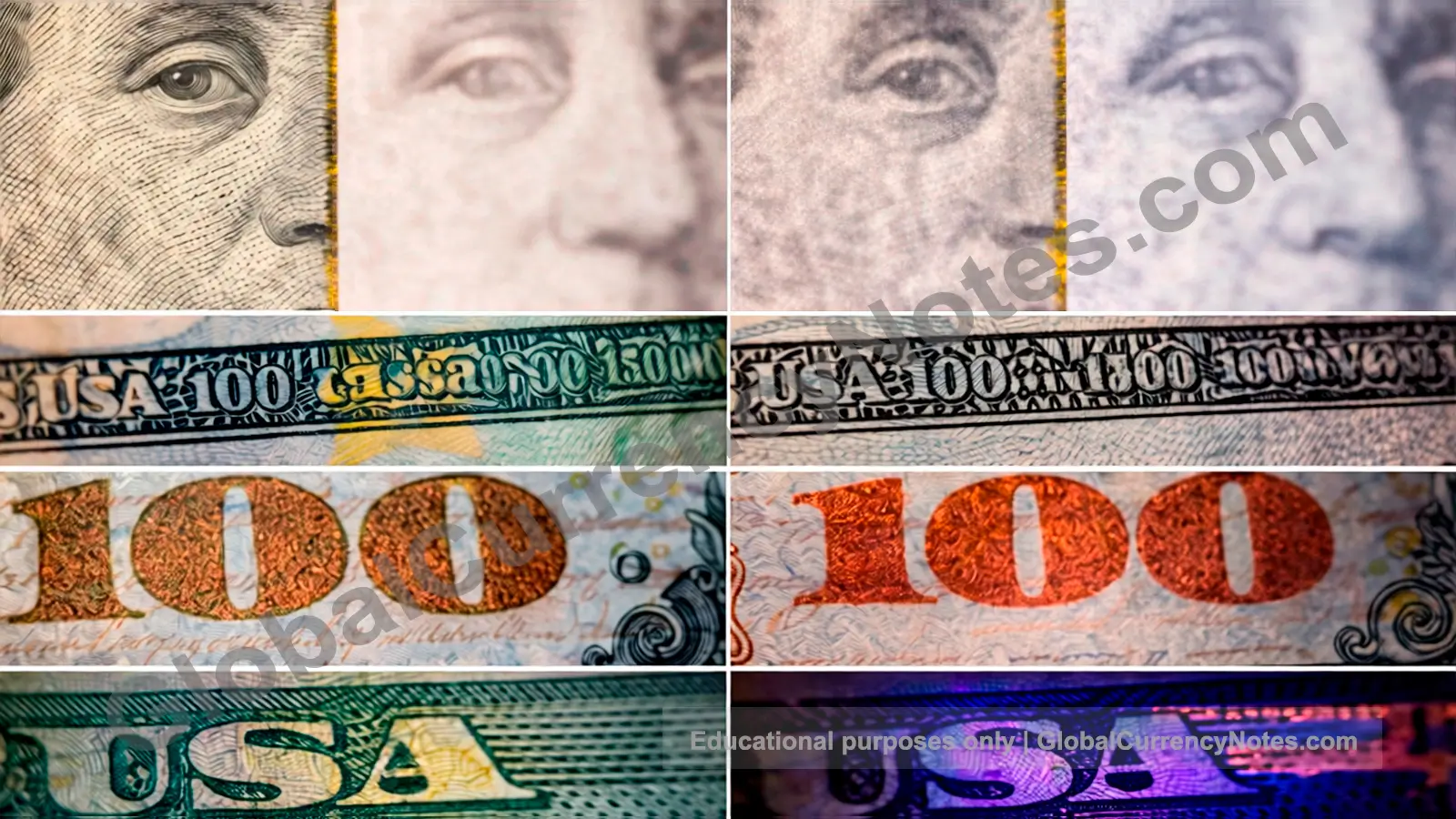
Modern US $20 bills incorporate numerous security features including color-shifting ink in the lower right corner denomination, embedded security thread visible when held to light, watermarks showing Andrew Jackson’s portrait, and microprinting throughout the design. However, many counterfeit $20 bills rely on unsophisticated consumers or rushed transactions where these features go unchecked. The most common counterfeits use basic inkjet or laser printing on standard paper, detectable through simple texture tests but often passing in casual exchanges where verification is minimal.
Euro €20 and €50: Europe’s Counterfeiting Challenge
The Euro presents unique counterfeiting challenges due to its use across 20 European Union member states, creating extensive circulation territory with varying enforcement capabilities. The €20 and €50 notes together account for approximately 75% of detected Euro counterfeits according to European Central Bank reports. The ECB reported about 467,000 counterfeit Euro banknotes removed from circulation in the second half of 2023, with these two denominations representing the vast majority of detected fakes.
The €20 note serves similar transactional purposes to the US $20, making it common in retail environments where verification may be cursory. The €50 note, while higher in value, remains frequently used for moderate purchases, particularly in countries where €50 notes circulate more commonly than in others. This dual-target pattern means counterfeiters can choose between two profitable denominations depending on their capabilities, equipment, and target markets within different European regions.
Euro security features have evolved significantly since the currency’s introduction in 2002. The Europa series, introduced starting in 2013, includes enhanced security elements such as portrait watermarks visible from both sides, emerald number color-shifting ink, and enhanced holographic features. Despite these improvements, counterfeiters continue targeting these denominations, though detection rates have improved as authentication technology becomes more sophisticated and widely deployed across European banking and retail sectors.
Why These Denominations Are Targeted
Counterfeiting economics drive denomination selection as criminals seek optimal return on investment for their illegal activities. Producing convincing counterfeit currency requires initial investment in equipment, materials, and expertise. Counterfeiters must balance production costs against expected profits while managing circulation risks that could lead to detection and prosecution. Mid-range denominations like $20 and €20-€50 offer the best compromise between these competing factors according to law enforcement analysis.
Transaction frequency plays a crucial role in counterfeiting success. Notes changing hands multiple times daily in routine commerce have higher chances of passing undetected than rarely circulated high denominations. A counterfeit $20 used at a busy coffee shop might circulate through several subsequent transactions before detection, while a fake $100 presented at a bank would likely face immediate scrutiny including UV light verification. This circulation dynamic makes frequent-use denominations more attractive to counterfeiters despite lower per-note value.
Detection risk varies significantly by denomination based on merchant behavior. Businesses and individuals routinely accept $20 and €20 notes without special verification equipment, relying instead on casual visual inspection that may miss sophisticated security features. Higher denominations typically trigger more careful examination, counterfeit detection pen tests, or even verification under UV light. This heightened scrutiny for large bills significantly reduces successful circulation of fake high-denomination notes, steering counterfeiters toward mid-range values where security consciousness remains lower in typical retail transactions.
British Pound and Other Frequently Counterfeited Banknotes
The British pound sterling faces its own counterfeiting challenges, with the £20 note historically representing the most commonly faked denomination among UK currency. The Bank of England reported approximately 210,000 counterfeit Bank of England notes removed from circulation in 2022, with £20 notes comprising roughly 90% of detected fakes according to official statistics. The introduction of polymer £20 notes in 2020 has helped reduce counterfeiting, though criminals continue adapting their techniques to target this widely-used denomination.
Other major currencies experience similar patterns in their most counterfeited banknotes. The Canadian $20 bill faces counterfeiting pressure despite Canada’s early adoption of polymer banknotes with advanced security features. Australian $50 and $100 notes, while polymer-based and technically advanced, still see counterfeiting attempts, though at significantly lower rates than paper currency systems that lack similar protective technologies. Japanese yen counterfeiting remains relatively rare globally, partly due to sophisticated security features and Japan’s relatively closed currency circulation system with limited international usage.
Emerging market currencies often face higher counterfeiting rates due to less sophisticated security features and weaker enforcement infrastructure compared to developed economies. However, these currencies’ limited international circulation means counterfeiting remains primarily domestic problems rather than global concerns. The US dollar and Euro dominate international counterfeit statistics because of their widespread use in global commerce and their acceptance far beyond their countries of origin, creating larger target markets for counterfeiters.
Counterfeiting Methods and Technology
Modern counterfeiting operations range from sophisticated criminal enterprises using professional-grade printing equipment to amateur operations relying on consumer-level inkjet printers. The most convincing counterfeits employ offset printing techniques that replicate the intaglio printing texture genuine banknotes use, though acquiring and operating such equipment requires significant investment and expertise. These high-quality counterfeits represent a small minority of fake notes but pose the greatest detection challenges for businesses and individuals handling cash.
Most counterfeit notes detected in circulation come from much simpler production methods. Basic inkjet or laser printers combined with photo editing software allow criminals to create passable fakes on standard paper. These counterfeits rely on casual inspection rather than sophisticated replication of security features. While such notes fail under close examination, they can succeed in rushed transactions or low-light retail environments where cashiers may not notice missing watermarks or improper paper texture.
Digital technology has both helped and hindered counterfeiting prevention efforts. Modern software and printers make basic counterfeiting more accessible, lowering barriers to entry for would-be criminals. However, this same technology enables more sophisticated authentication tools for detecting fakes. Currency scanners, UV lights, and automated verification systems have become more affordable and widespread, particularly in banking and high-volume retail settings, helping to intercept many counterfeit notes before they circulate widely.
How to Detect Counterfeit Banknotes
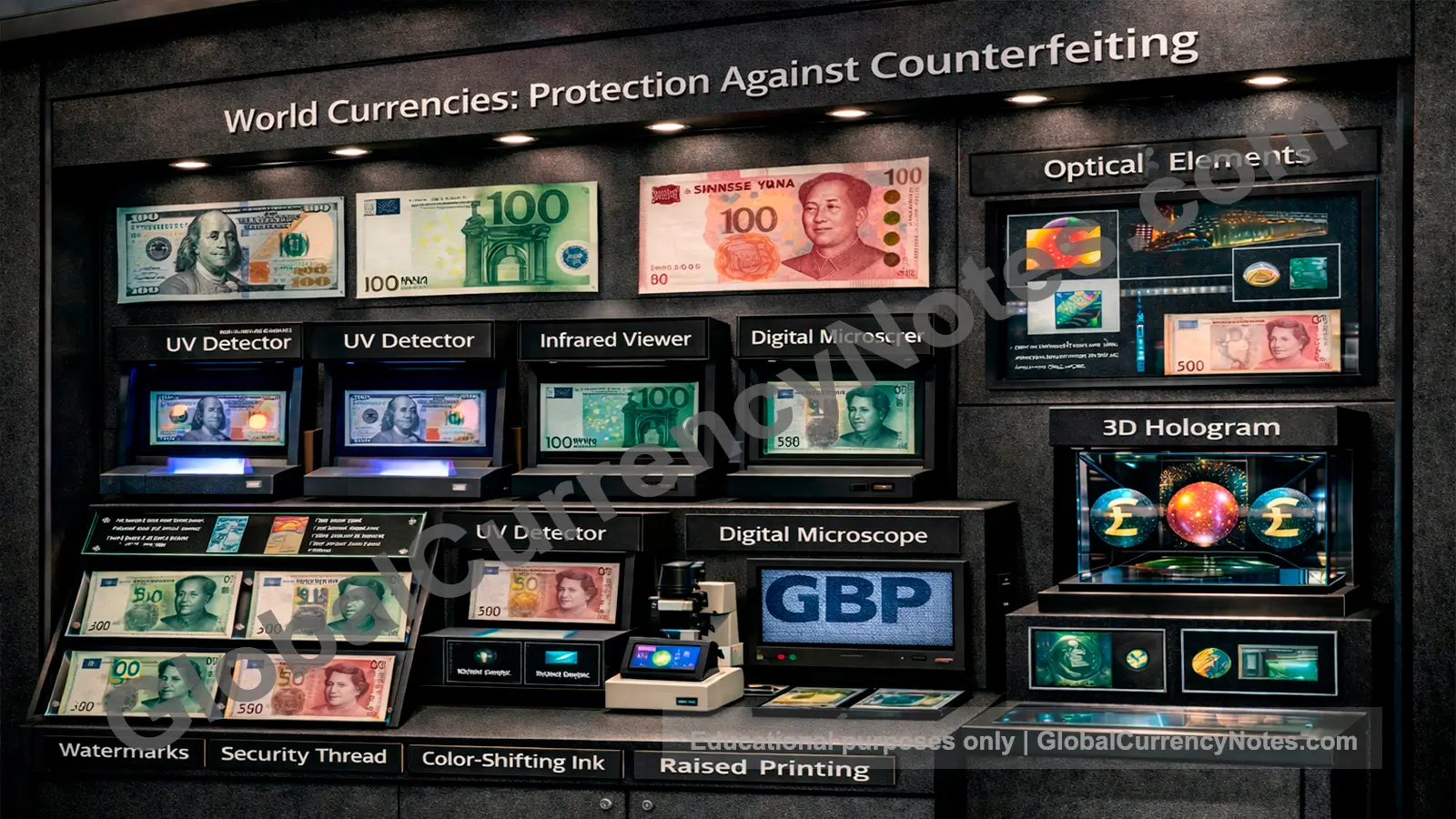
Effective counterfeit detection relies on examining multiple security features rather than depending on single verification methods. The «feel, look, and tilt» approach recommended by currency authorities provides a systematic framework for authentication. Genuine currency feels different due to distinctive paper composition—US notes use cotton-fiber paper with embedded red and blue fibers, while many modern currencies use polymer with unique tactile properties that standard paper cannot replicate.
Visual inspection should focus on specific security elements that counterfeiters find difficult to reproduce accurately. Watermarks, visible when holding notes to light, appear as distinct portraits or patterns embedded in the paper itself. Security threads running vertically through notes display text or numbers visible when backlit. Color-shifting ink, used on many denominations, changes appearance when tilting the note, transitioning between colors like copper and green in ways standard ink cannot duplicate.
Advanced verification tools provide additional confidence for high-value transactions. UV lights reveal fluorescent security features invisible under normal lighting. Counterfeit detection pens, while limited in scope, offer quick preliminary screening for starch-based paper that counterfeiters often use. Automated currency scanners used in banking and retail settings employ multiple detection technologies simultaneously, catching most counterfeits before they enter circulation through business channels that use such equipment.
Impact of Counterfeiting on Economy and Business
Counterfeiting imposes economic costs beyond the direct value of fake notes in circulation. Businesses accepting counterfeit currency lose both the face value of the fake note and the goods or services provided in exchange, as law enforcement typically confiscates detected counterfeits without compensation. These losses particularly affect small businesses operating on thin profit margins where a single counterfeit $20 or €20 represents meaningful financial impact.
Broader economic effects include reduced confidence in currency and increased transaction costs for verification. Merchants investing in authentication equipment, training staff on security features, and implementing verification procedures all face costs ultimately passed to consumers through pricing. Banking systems must maintain counterfeit detection infrastructure, destroying fake notes and coordinating with law enforcement, activities funded through general banking operations.
Currency authorities face ongoing expenses developing and implementing new security features to stay ahead of counterfeiting technology. Redesigning notes, upgrading printing equipment, and phasing out older designs while maintaining backward compatibility requires substantial investment. These costs, while necessary for maintaining currency integrity, represent public funds that could otherwise serve different purposes. The economic race between counterfeiters and currency issuers continues as long as physical cash remains in widespread use.
Frequently Asked Questions About Counterfeited Banknotes
Which banknotes are counterfeited most frequently worldwide?
The US $20 bill and Euro €20 and €50 notes represent the most counterfeited banknotes globally according to available law enforcement data. These denominations balance sufficient value to justify counterfeiting effort against common circulation that reduces detection likelihood. The British £20 note also faces significant counterfeiting pressure in UK markets. These patterns reflect criminal economic calculations seeking optimal profit-to-risk ratios rather than simply targeting highest-value denominations. However, counterfeiting statistics vary by region and may not capture all fake currency in circulation, as detection rates depend on enforcement capabilities and reporting systems.
Are higher denomination bills counterfeited more often?
No, mid-range denominations like US $20 and Euro €20-€50 face higher counterfeiting rates than large bills according to official statistics. While high denominations offer greater per-note value, they receive more scrutiny during transactions and circulate less frequently, making them harder to pass successfully. Counterfeiters prefer denominations common enough to avoid suspicion but valuable enough to justify production effort. The $100 bill accounts for only about 15-20% of US counterfeit cases despite its higher value, reflecting these circulation and detection dynamics. However, specific rates vary by region and enforcement effectiveness.
How common is counterfeit currency in everyday circulation?
Counterfeit currency represents a very small fraction of total circulation in developed economies with modern security features. In the United States, estimates suggest fewer than 1 in 10,000 bills in circulation are counterfeit based on detection data. Euro counterfeiting rates are similarly low, with detected fakes representing about 18 per million genuine notes in circulation according to ECB reports. Most people will never knowingly encounter a counterfeit banknote, though the risk increases in cash-intensive businesses that handle large transaction volumes without proper verification procedures. However, actual counterfeit rates may be higher than detected rates, as not all fake notes are identified before destruction.
Do counterfeit detection pens really work?
Counterfeit detection pens provide limited effectiveness as they only test for starch content in paper. Genuine US currency uses cotton-fiber paper without starch, causing the pen to leave a pale mark, while standard printer paper containing starch produces a dark mark. However, counterfeiters can defeat this test by using starch-free paper or treating regular paper chemically to remove starch. Pens serve as a quick preliminary check but should not be the only verification method. Examining multiple security features like watermarks, security threads, and color-shifting ink provides more reliable authentication. This testing method should be considered one part of a comprehensive verification approach rather than a definitive authentication tool.
Why don’t counterfeiters target rare or valuable banknotes?
Rare collectible banknotes and very high denominations present poor targets for counterfeiters because they face immediate expert scrutiny that makes successful circulation nearly impossible. Collectors and dealers examining rare notes carefully inspect every detail and often use professional authentication services with specialized equipment. High denominations like $500 or $1,000 bills (no longer printed but still legal tender) would be immediately suspicious in everyday transactions and would likely be verified professionally. Counterfeiters succeed by exploiting routine transactions where verification is cursory, not by attempting to fool expert numismatists or specialized authentication equipment. The economics of counterfeiting require volume circulation, which rare and high-value notes cannot provide.
Has polymer currency reduced counterfeiting?
Yes, countries adopting polymer banknotes have generally experienced significant counterfeiting reductions according to available data. Polymer notes incorporate security features difficult to replicate, including transparent windows, complex holograms, and tactile elements that standard printing cannot reproduce accurately. Canada saw counterfeit rates drop by approximately 80% after introducing polymer notes according to reported statistics. However, counterfeiters eventually adapt their techniques as they gain familiarity with new technologies, and polymer adoption alone does not eliminate counterfeiting permanently. The technology provides a significant advantage when first introduced, though maintaining low counterfeiting rates requires continuous security feature updates regardless of substrate material used for production.
Can counterfeit currency be detected by touch alone?
Experienced handlers can often identify counterfeits through touch, though this method is not foolproof and should be combined with visual inspection. Genuine currency uses intaglio printing that creates distinctive raised texture on portraits and main design elements. Most counterfeits feel flat and smooth because they use standard printing methods on regular paper that cannot replicate this tactile quality. However, some sophisticated counterfeits attempt to replicate this texture through various techniques, and inexperienced handlers may not detect subtle differences reliably. Touch should be combined with visual inspection of security features for reliable authentication. Bank tellers and cash handlers develop tactile sensitivity through repeated exposure to genuine notes, but this skill requires substantial experience and should not be considered infallible.
Disclaimer: Information provided is for educational purposes only and does not constitute professional advice. Banknote standards and regulations vary by jurisdiction and are subject to change. Readers should exercise their own judgment. For full legal disclosures and liability limitations, visit our Legal Notice.