Part of: Banknote Types & Materials
Exploring different types of banknotes, their materials, and the factors that influence their design, value, and collectibility across different currencies and historical periods.
Most valuable banknotes reach extraordinary prices at auction, driven by rarity, historical significance, and condition rather than face value alone. According to auction records, the current record holder is reportedly the 1890 United States Grand Watermelon $1,000 Treasury Note, which sold for approximately $3.29 million in 2014. This remarkable price reflects the note’s exceptional rarity and distinctive design. Fewer than seven examples are believed to exist. The reverse features ornate patterns resembling watermelon slices.
Banknote value depends on multiple interconnected factors that collectors and numismatic specialists evaluate when determining worth. Printing errors, limited production runs, and historical circumstances create scarcity that drives collector demand. A note’s condition, measured on professional grading scales, significantly impacts market value. Provenance, or documented ownership history, adds premium value when valuable banknotes come from famous collections or represent unique historical moments. Understanding these factors helps explain why certain notes command prices thousands of times above their original face value, though actual market values can fluctuate significantly based on collector demand and economic conditions.
The market for valuable banknotes operates through specialized auction houses, private dealers, and numismatic organizations, though this market can be highly specialized and relatively illiquid compared to traditional investments. Major auction events regularly feature valuable banknotes selling for six or seven figures, attracting collectors worldwide. While some rare banknotes have historically shown price appreciation over time, past performance does not guarantee future results. The collectible currency market involves significant specialized knowledge, authentication requirements, and market volatility that prospective collectors should carefully consider.
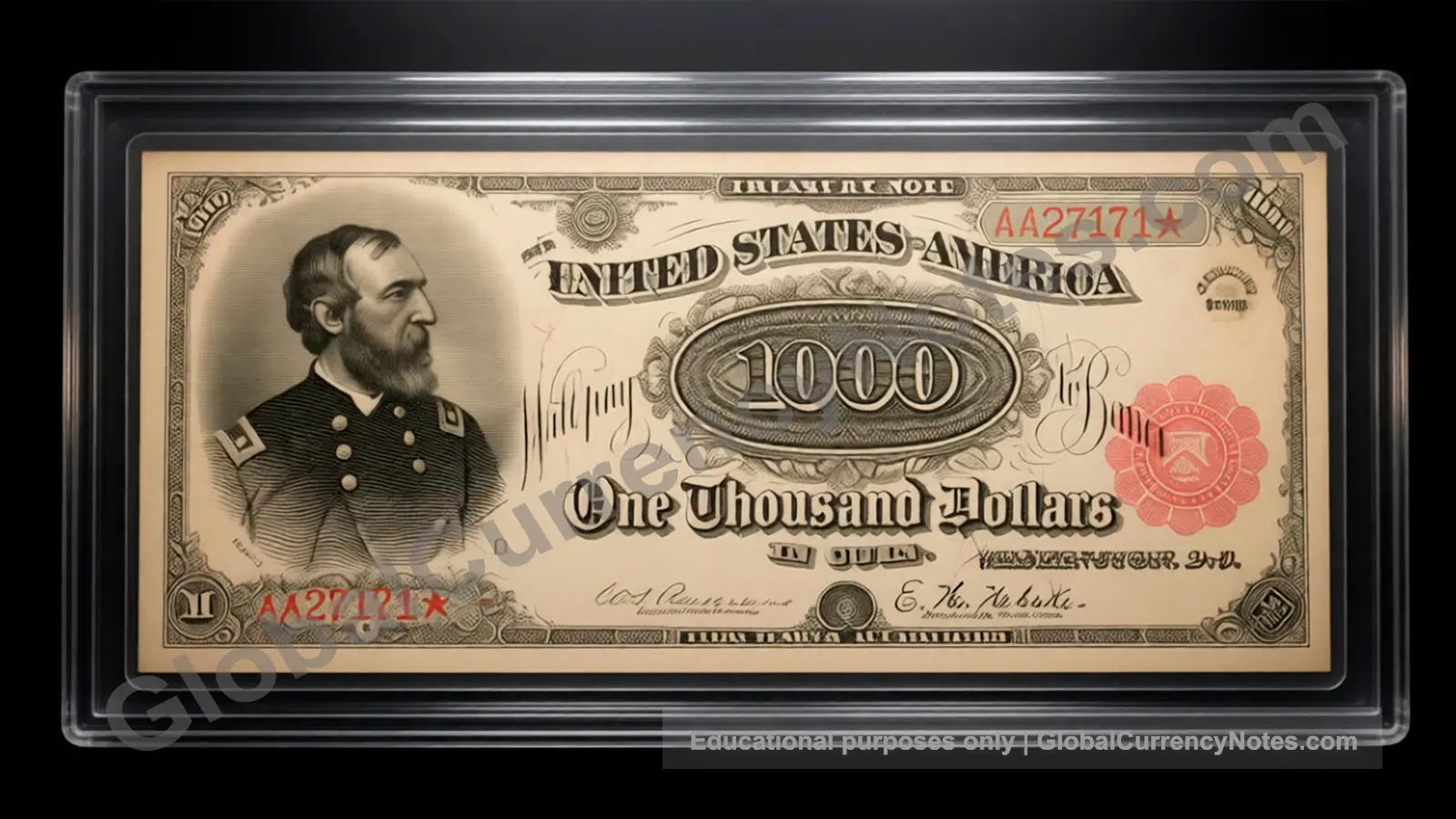
Most Valuable Banknotes: The Grand Watermelon Record
The 1890 Grand Watermelon $1,000 Treasury Note achieved its record-breaking sale at Heritage Auctions in January 2014. The reported final price reached approximately $3.29 million according to auction records. The note features General George Gordon Meade’s portrait on the obverse, surrounded by elaborate intaglio engraving. Intaglio is a printing technique where images are incised into a surface, typical of late 19th-century currency design. The reverse displays large ornamental zeros that collectors nicknamed «watermelons» due to their distinctive shape and green coloring, creating the note’s popular designation among valuable banknotes.
Extreme rarity drives the Grand Watermelon’s exceptional value in the numismatic market. The Bureau of Engraving and Printing produced these notes in very limited quantities during 1890-1891. Most were redeemed and destroyed decades ago according to historical records. Numismatic researchers have documented fewer than seven surviving examples believed to exist, with only three or four estimated to be in private hands. The 2014 auction specimen received a grade of PMG 30 Very Fine. This professional grading scale indicates moderate circulation but no major defects, representing relatively strong condition for a note over 130 years old.
The sale represented more than just a price record for valuable banknotes. It demonstrated sustained collector interest in United States large-size currency from the pre-Federal Reserve era. The note’s elaborate security features, including complex geometric patterns and high-quality intaglio printing, showcase 19th-century printing craftsmanship at its peak. These aesthetic qualities, combined with historical significance and documented scarcity, created conditions favorable for record-setting value, though future market conditions and collector demand may vary.
Valuable Banknotes from Modern Circulation: British £5 Notes
In 2016, the Bank of England introduced polymer £5 notes featuring Sir Winston Churchill. Four special specimens included tiny portraits of Jane Austen micro-engraved onto the note’s surface by artist Graham Short. These microscopic artworks measured approximately 5mm in height and required magnification to view clearly. The micro-engravings appeared in the queen’s shoulder area on selected notes released into general circulation.
According to reports, one of these special notes sold for approximately £16,800 in 2017, representing roughly 3,360 times its face value. The novelty of finding genuine legal tender currency with hidden artwork created significant public interest and media coverage. Unlike intentionally produced commemorative notes, these specimens entered regular circulation. Discovery depended on careful examination and considerable luck. The artistic challenge of creating micro-engravings at such small scale added cultural value beyond typical numismatic factors that determine value for most valuable banknotes.
The micro-engraved notes demonstrated how contemporary interventions can transform ordinary currency into collectible items. Such value is highly dependent on collector interest and market demand. While the Bank of England did not officially sanction these additions, they maintained legal tender status since the base notes remained genuine and unaltered in their essential security features. This created an unusual situation where artistic modification increased rather than decreased value, contrasting with typical defacement that renders currency worthless. The long-term collectible value of such pieces remains subject to market conditions.
Highest Denomination Notes Currently Circulating
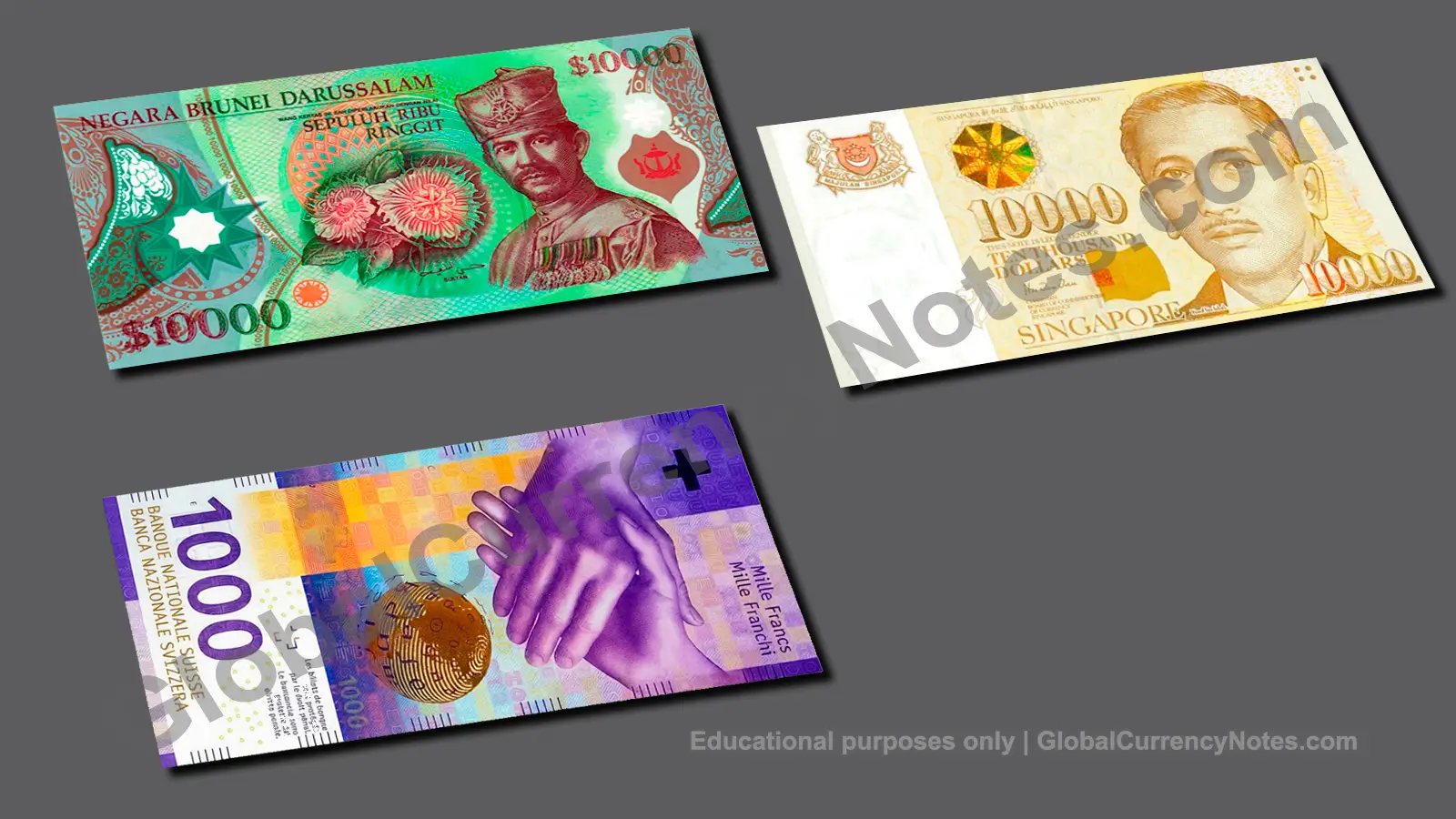
Singapore maintains what is widely considered the world’s highest denomination banknote in active circulation with its $10,000 note. The note is equivalent to approximately $7,400 USD based on current exchange rates. The Monetary Authority of Singapore continues producing these notes despite their limited use in daily transactions. The portrait series features Singapore’s first president, Encik Yusof bin Ishak, while newer issues display the nation’s first prime minister. The notes incorporate advanced polymer security features including transparent windows and color-shifting elements.
Brunei also issues $10,000 notes featuring Sultan Hassanal Bolkiah. These notes maintain interchangeability with Singapore currency under a Currency Interchangeability Agreement dating to 1967 according to Monetary Authority of Singapore documentation. Both nations’ high-denomination notes serve primarily institutional and high-value transaction purposes rather than general retail use. Banks stock them for specific business needs, but average consumers rarely encounter these denominations in everyday commerce.
Switzerland’s 1,000 franc note, worth approximately $1,170 USD based on current exchange rates, represents Europe’s highest denomination in regular circulation. Similar to historically large banknotes, these high-denomination notes serve specialized purposes rather than everyday transactions. The Swiss National Bank redesigned this note in 2019 with enhanced security features and vertical orientation, departing from traditional horizontal layouts. The violet-colored note depicts Swiss contributions to global culture through various artistic and scientific themes. Despite some international pressure to discontinue high-denomination notes due to concerns about potentially facilitating certain transactions, Switzerland maintains production citing legitimate business needs and citizen preference for cash transactions, though policies may change over time.
Factors That Determine Value for Valuable Banknotes
Rarity and Scarcity Factors
Rarity stands as a primary value driver in numismatics, though rarity alone does not guarantee high value for valuable banknotes. Notes with small production runs, limited distribution, or high redemption rates become scarce over time. Printing errors that escaped quality control create unintentional rarities highly prized by specialists. Production mistakes like inverted designs, missing elements, or incorrect serial numbers can transform ordinary notes into valuable collector items. However, the relationship between rarity and value depends significantly on collector demand, which can fluctuate based on market conditions and collecting trends.
Condition and Professional Grading
Condition profoundly affects value through professional grading systems, though grading itself involves some subjectivity. Organizations like Paper Money Guaranty (PMG) and PCGS Currency assign numerical grades from 1 to 70, with higher numbers indicating better preservation. Uncirculated notes showing no signs of handling typically command substantial premiums over circulated examples. Even within circulated grades, differences between Very Fine (typically 20-35 on grading scales) and Extremely Fine (40-45) condition can mean thousands of dollars in value variation for rare notes. Understanding banknote materials and production methods helps explain why certain notes withstand time better than others. Professional authentication and grading provide confidence to buyers and establish standardized value benchmarks, though market prices ultimately depend on actual transaction results.
Historical Significance and Provenance
Historical significance can elevate certain valuable banknotes beyond typical collectible status. Significance is often subjective and culturally dependent. Currency from pivotal events, short-lived governments, or important economic transitions attracts premium interest from certain collectors. Notes representing technological innovations in printing, security features, or materials development appeal to specialists studying currency evolution. Association with famous individuals, whether through signatures or historical circumstances, adds provenance value that some collectors particularly prize. These contextual factors create emotional and intellectual appeal beyond simple scarcity, though their impact on market value varies considerably based on collector preferences.
Notable Auction Records for Valuable Banknotes
United States Treasury Notes
According to auction records verified by the American Numismatic Association, the reported $2.04 million sale of an 1891 «Red Seal» $1,000 Treasury Note in 2013 demonstrated strong market demand for rare United States currency predating the Federal Reserve. This note, graded PMG 64 Choice Uncirculated, represented exceptional preservation for 19th-century paper money. Its relatively high grade, combined with the Red Seal variety’s scarcity, contributed to the seven-figure price. The sale occurred just months before the Grand Watermelon record, indicating sustained collector enthusiasm for high-denomination Treasury Notes during that period, though such market strength can vary over time.
Federal Reserve Notes and International Examples
A 1934 $10,000 Federal Reserve Note featuring Salmon P. Chase reportedly achieved approximately $384,000 at auction in 2014 according to available records. While this represents a substantial premium over face value, it demonstrates that condition and rarity create significant value variations even among notes sharing the same denomination. The $10,000 denomination, discontinued in 1969, represents the highest-value United States currency officially issued for general circulation. Most examples were returned to the Federal Reserve and destroyed. This makes surviving specimens particularly sought after by collectors of valuable banknotes, though actual market prices depend on specific condition and provenance factors.
International valuable banknotes have also achieved notable auction results, though comprehensive records can be more difficult to verify. A specimen of the 1856 Straits Settlements $100 note reportedly sold for approximately $110,000 according to numismatic sources, representing significant value for Southeast Asian colonial currency. The note’s historical significance from the British colonial period, combined with its rarity, attracted serious collector interest. These international examples demonstrate that the market for valuable banknotes extends globally. Liquidity, authentication requirements, and market depth vary significantly across different currency specializations.
Frequently Asked Questions About Valuable Banknotes
Can you find valuable banknotes in everyday circulation?
Finding genuinely valuable banknotes in everyday circulation is extremely unlikely in developed countries with modern currency systems. Most valuable banknotes date from decades or centuries past and have long since been removed from circulation through redemption or collector acquisition. The British micro-engraved £5 notes represented rare exceptions where valuable specimens deliberately entered circulation. Standard circulating currency typically maintains only face value unless containing significant printing errors, which quality control systems generally prevent from reaching public distribution. Anyone finding an apparently unusual note should have it authenticated by professional numismatic services before assuming significant value, as condition, authenticity, and actual market demand ultimately determine worth.
How do auction houses determine starting prices for rare valuable banknotes?
Auction specialists research recent comparable sales, consult published price guides, and evaluate the specific note’s condition and characteristics when establishing estimates. Rarity population reports, professional grade, provenance documentation, and current market trends inform these estimates. Houses typically set conservative starting bids below expected final prices to encourage bidding participation. Pre-auction interest and advance bidding help gauge likely final prices. Catalogers balance attracting bidders through reasonable reserves while protecting consignor interests by preventing undervalued sales. However, actual final prices can vary significantly from estimates based on bidder interest, market conditions at the time of sale, and other unpredictable factors. These estimates should not be considered appraisals or guarantees of value.
Do valuable banknotes maintain their worth during economic downturns?
The relationship between rare banknote values and general economic conditions is complex and varies significantly by specific collectible and market segment. Top-tier rarities with established historical importance have sometimes maintained value better than common collectibles during economic disruptions, though this is not guaranteed. Market illiquidity means prices may not reflect real-time economic changes immediately. Severe recessions can reduce collector spending and temporarily affect prices, particularly for mid-tier collectibles. Long-term appreciation trends for genuine rarities have historically continued across economic cycles in some cases, though short-term price volatility can occur during major financial disruptions. Past performance should not be interpreted as indicating future results. The collectible currency market carries significant risks including illiquidity, authentication challenges, and market volatility. Professional financial advice specific to individual circumstances is strongly recommended before considering collectibles as investments.
What’s the difference between high face value and high collector value in valuable banknotes?
Face value represents the denomination printed on the note and its worth in official transactions when the note remains legal tender, while collector value reflects market price based on rarity, condition, historical significance, and collector demand. A Singapore $10,000 note has high face value and can be used at that value for transactions, but typically trades near face value in currency markets due to continued production and availability. The Grand Watermelon’s $1,000 face value means little compared to its reported $3.29 million collector value driven by extreme rarity and condition. Many valuable banknotes have modest face values but command enormous premiums due to scarcity and historical importance. However, collector value is subject to market fluctuations, authentication requirements, and can vary significantly based on actual transaction circumstances rather than published price guides.
How can someone start collecting valuable banknotes responsibly?
Begin with education through numismatic organizations, reference books, and auction catalogs to study grading standards, authentication techniques, and market values before making purchases. Start with more affordable notes in areas of personal interest rather than expensive rarities. Purchase from reputable dealers or auction houses offering authenticity guarantees and reasonable return policies. Join collector organizations providing educational resources and networking opportunities. Focus on quality over quantity, buying the best condition affordable rather than accumulating many lower-grade examples. Consider professional grading for valuable acquisitions to ensure authenticity and establish objective condition assessment. Be aware that the collectible banknote market involves significant risks including authentication challenges, market volatility, illiquidity, and the need for specialized knowledge. Values can decrease as well as increase, and selling collectibles may be difficult and time-consuming. Professional guidance from experienced numismatists is strongly recommended, particularly for significant purchases.
Are there tax implications for buying and selling valuable banknotes?
In most jurisdictions, profits from selling collectibles including banknotes may be subject to capital gains taxation, though specific regulations vary significantly by country and individual circumstances. Some regions classify collectibles differently from securities for tax purposes, potentially resulting in different tax treatment and rates. The distinction between investment activity and hobby collecting can also affect tax treatment in some jurisdictions. Professional tax advice specific to your location, financial situation, and collecting activities is essential for compliance with applicable laws. Accurate record keeping documenting purchase prices, sale proceeds, transaction dates, and related expenses helps establish cost basis for tax reporting purposes. Insurance values differ from tax basis and should not be confused when calculating gains or losses. This information is not tax advice, and tax laws change over time and vary significantly by jurisdiction.
How is authenticity verified for valuable banknotes?
Professional authentication for valuable banknotes involves examination by experienced numismatists using specialized equipment and knowledge of security features, paper characteristics, printing techniques, and known counterfeits. Established grading services like Paper Money Guaranty (PMG) and PCGS Currency provide third-party authentication and grading, encapsulating notes in protective holders with certification labels. Authentication examines multiple factors including paper composition, printing quality, security features appropriate to the issue, serial number characteristics, and comparison with documented genuine examples. However, sophisticated counterfeits exist for valuable notes, and authentication involves some degree of expert judgment. Even professional services occasionally make errors or update opinions based on new information. Multiple expert opinions and continuing research may be appropriate for particularly rare or valuable pieces. Buyers should only purchase significant items from reputable sources offering authenticity guarantees and should understand the limitations and risks inherent in the authentication process.
Disclaimer: Information provided is for educational purposes only and does not constitute professional advice. Banknote standards and regulations vary by jurisdiction and are subject to change. Readers should exercise their own judgment. For full legal disclosures and liability limitations, visit our Legal Notice.