Part of: Banknote Security
Comprehensive guide to the multiple layers of security technologies protecting United States currency from counterfeiting and fraud.
US dollar security features protect American currency from counterfeiting through multiple layers of advanced technologies developed over several decades of continuous improvement. According to the U.S. Currency Education Program, modern US banknotes incorporate tactile elements, color-shifting inks, embedded security threads, watermarks, and machine-readable features that work together to create what is considered one of the world’s most sophisticated currency security systems.
The United States periodically redesigns its currency to stay ahead of evolving counterfeiting techniques. According to the Bureau of Engraving and Printing, major security updates have been implemented at various intervals over the past several decades, with planned future enhancements as part of ongoing anti-counterfeiting efforts.
Understanding these security features helps users protect themselves against counterfeits, which, while representing a small fraction of currency in circulation due to effective detection efforts, remain a persistent concern requiring ongoing vigilance and technological innovation.
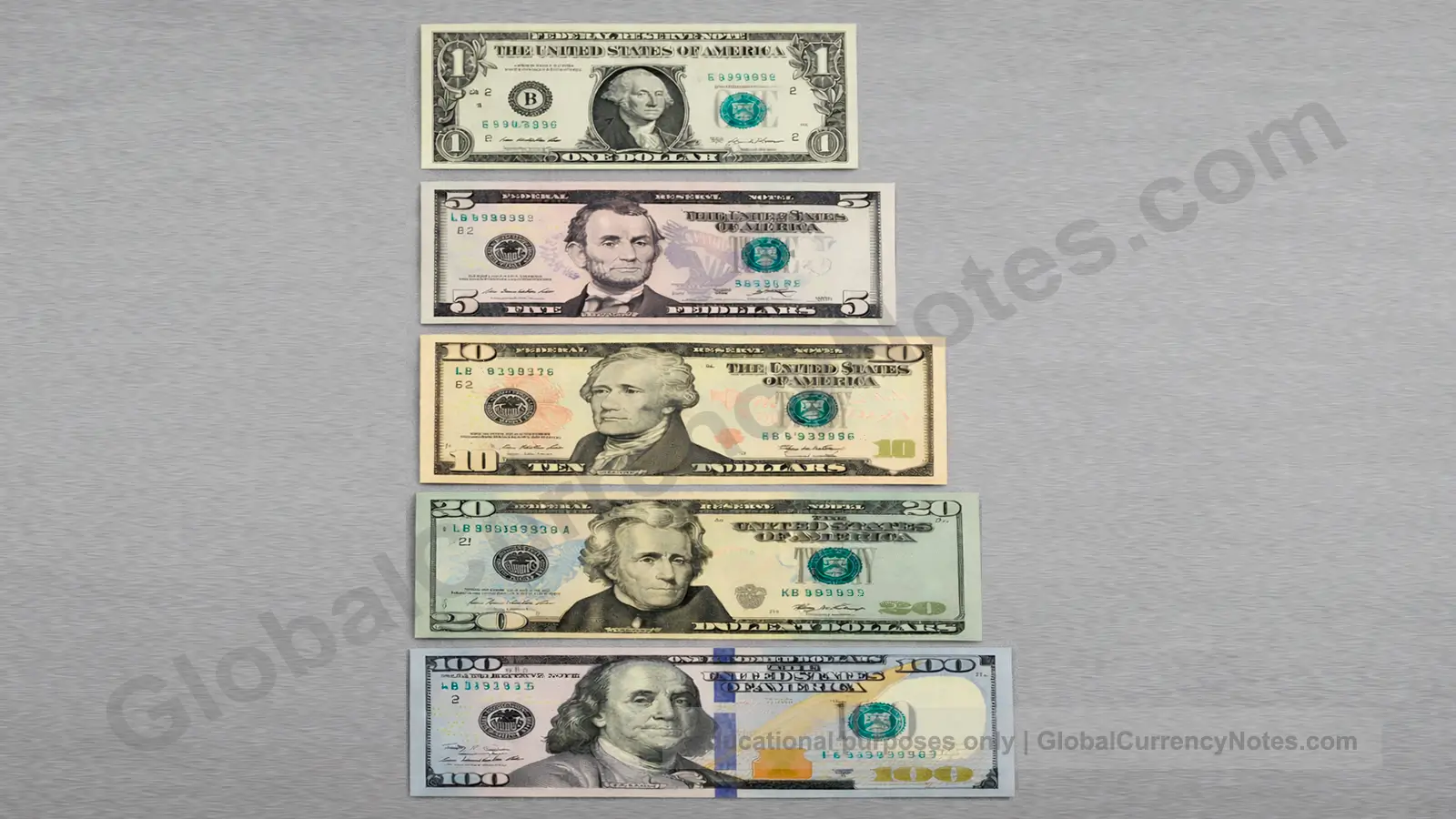
Core Security Features Across Denominations
US currency incorporates multiple security features, though the specific technologies vary by denomination. Higher-value notes typically contain more advanced protections, while lower denominations use a more streamlined feature set based on counterfeiting risk assessment.
Watermark Portrait
Most denominations (except $1 and $2 bills) contain a watermark visible when held up to light. This embedded image typically duplicates the portrait on the front of the note and appears as part of the paper itself rather than being printed on the surface. Genuine watermarks require specialized papermaking equipment and processes, making them difficult to replicate convincingly.
Security Thread
A thin vertical strip embedded in the paper runs through most bills (except $1 and $2). The thread’s position and characteristics vary by denomination, helping verify the correct value. Under ultraviolet light, these threads emit distinct colors that vary by denomination, providing quick visual verification without requiring detailed examination.
Color-Shifting Ink
Bills of $10 and higher use optically variable ink that changes color when tilted. This ink contains microscopic metallic components that reflect light differently at various angles, creating an effect that is challenging to replicate with standard printing equipment.
Raised Printing (Intaglio)
Genuine US currency uses intaglio printing, which creates slightly raised ink that can be felt by touch. This distinctive texture appears on key design elements including the portrait, seals, and serial numbers. The raised effect results from specialized engraving and printing techniques that require significant equipment investment.
Microprinting
Tiny text appears in multiple locations on each bill, generally readable only with magnification. Standard photocopiers and printers typically produce these fine details as blurred lines rather than sharp text, making this an effective anti-counterfeiting measure.
Red and Blue Fibers
Tiny red and blue synthetic fibers are embedded throughout the paper during manufacturing. These fibers appear as small colored threads and are visible under magnification. Genuine fibers are embedded within the paper structure rather than printed on the surface.
Serial Numbers
Two identical serial numbers appear on each note, with specific formatting conventions for letter-number combinations. Genuine notes use consistent spacing, specific fonts, and uniform ink application. Authorities also track serial number ranges to help identify counterfeit batches.
Evolution of US Dollar Security
US currency security has evolved through several major redesign periods, each introducing new technologies to address increasingly sophisticated counterfeiting methods.
1990s: Modern Security Era
Significant security upgrades in the 1990s added embedded security threads and microprinting to most denominations. This period marked the beginning of layered security features designed to be verified without specialized equipment.
1996: Major Redesign
This redesign introduced watermarks, color-shifting ink, and repositioned portraits across several denominations. The larger, off-center portraits facilitated watermark integration and reduced blank space. Federal Reserve indicators were repositioned to improve automated processing.
2013: Advanced Technology
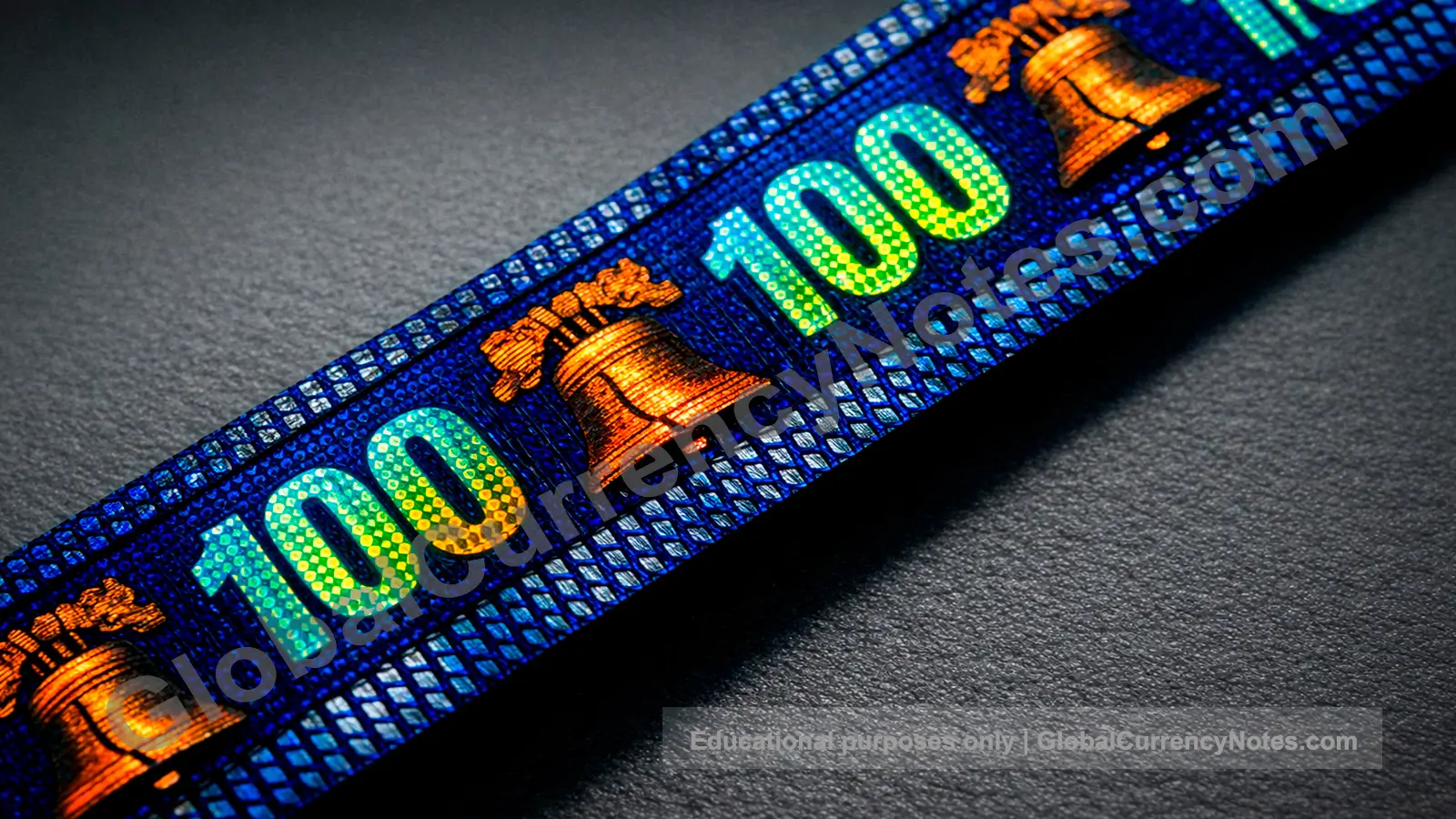
The redesigned $100 bill introduced the 3D Security Ribbon, a blue woven strip containing microscopic lenses that create moving images when tilted. This same note added a color-shifting Liberty Bell in an inkwell. According to the Bureau of Engraving and Printing, development of these features required extensive research and testing.
Future Enhancements
The Advanced Counterfeit Deterrence Committee has announced plans for phased redesigns incorporating enhanced security features. While specific implementation timelines and exact features remain subject to ongoing development and security considerations, these updates will likely include both machine-readable elements and updated public security features. Actual release schedules may vary based on technical development, security assessments, and production requirements.
Security Features by Denomination
Different denominations incorporate varying levels of security technology based on counterfeiting risk assessment and production cost considerations.
$1 and $2 Bills
These notes contain fundamental security features: raised printing, serial numbers, embedded fibers, and official seals. The $1 bill has not undergone major security redesigns, as its low value makes counterfeiting economically less attractive. These bills typically circulate for several years before replacement due to wear.
$5 Bill
The $5 note includes a watermark, security thread (which emits a specific color under UV light), and microprinting. It lacks color-shifting ink present on higher denominations. These notes generally circulate for several years before replacement.
$10 Bill
This denomination includes standard features plus color-shifting ink. The security thread emits a characteristic color under UV light and is positioned in a specific location relative to the portrait. Typical circulation lifespan is several years.
$20 Bill
As one of the most widely circulated denominations, the $20 receives enhanced security attention. It features color-shifting ink, watermark, security thread, and extensive microprinting. This denomination also attracts significant counterfeiting attention. Typical lifespan in circulation is several years.
$50 Bill
The $50 incorporates advanced security features including color-shifting ink, watermark, and UV-reactive security thread. This denomination sees less circulation volume than $20 bills but contains sophisticated anti-counterfeiting technologies. Circulation lifespan is typically several years.
$100 Bill
The $100 bill contains the most advanced security features of any US denomination, including the 3D Security Ribbon and color-shifting Liberty Bell. As the most counterfeited denomination internationally, it receives the highest level of anti-counterfeiting technology. These notes typically remain in circulation for an extended period due to their high value and durability.
How to Verify US Dollar Authenticity
The recommended verification approach uses multiple checks rather than relying on a single feature.
Feel-Look-Tilt Method
This three-step verification works for most counterfeits without requiring special equipment:
Feel: Genuine currency has a distinctive texture from raised printing created by the intaglio process. Run your finger over the portrait and key design elements to detect this texture.
Look: Hold the bill up to light to see the watermark. The watermark should be visible from both sides and match the main portrait denomination. Also check for the embedded security thread.
Tilt: On denominations $10 and higher, tilt the note to observe color-shifting ink effects. The ink should change color noticeably as you change the viewing angle.
UV Light Verification
Under ultraviolet light, security threads emit distinct colors that vary by denomination. This provides quick verification, though UV lights are not essential for basic authentication using the feel-look-tilt method.
Professional Authentication
Banks and businesses handling large cash volumes typically use automated detection equipment that verifies multiple security features simultaneously. These systems check for proper paper composition, magnetic properties, UV characteristics, and other machine-readable elements.
Understanding Counterfeiting Threats
Most Targeted Denominations
The $100 bill faces significant international counterfeiting activity, particularly in regions where US dollars serve as an unofficial secondary currency. Domestically, the $20 bill attracts counterfeiting attempts due to its widespread circulation and general acceptance. Lower denominations see minimal counterfeiting activity, as production costs can approach or exceed face value.
Common Counterfeiting Methods
Modern counterfeiters primarily use high-quality digital printing equipment. One technique involves chemical treatment of genuine low-denomination notes to remove ink, then reprinting them as higher denominations. This method uses authentic paper but typically fails watermark verification, as the wrong portrait appears. Digital counterfeits often lack the raised texture and accurate color-shifting effects of genuine notes.
International Considerations
A substantial portion of US currency circulates outside the United States, making dollar security a concern with global implications. According to the Federal Reserve, international counterfeiting operations require coordination with foreign law enforcement to address effectively.

Future of US Dollar Security
Currency security continues evolving to address emerging threats from improved printing technology and digital tools.
Ongoing Development Programs
Planned redesigns will likely introduce enhanced machine-readable features alongside improved public security elements. These changes aim to strengthen automated authentication while maintaining manual verification capabilities. Development and implementation timelines for new currency features typically span many years due to extensive testing, security considerations, and production requirements.
Advanced Machine-Readable Features
Future notes will likely incorporate enhanced features detectable by automated systems at financial institutions and retail locations. These technologies work alongside visual features to create multiple authentication layers. Development focuses on features that remain difficult to replicate even with advanced equipment.
Balancing Security and Usability
Designers must balance sophisticated security with practical usability. Features should ideally remain verifiable without special equipment for ordinary users, while also providing high-tech elements for professional authentication. The substrate must maintain appropriate durability for extended circulation while incorporating complex security elements.
Global Coordination
As a primary global reserve currency, US dollar security affects international financial stability. The Federal Reserve coordinates with foreign central banks and law enforcement to share authentication knowledge and address international counterfeiting activities. This cooperation helps protect the currency’s credibility worldwide.
Frequently Asked Questions
What is the most advanced security feature on US dollars?
The 3D Security Ribbon on the $100 bill represents one of the most technologically sophisticated features currently in use. This woven blue strip contains microscopic lenses that create moving images when tilted. The feature required extensive development and uses technology that is challenging to counterfeit. However, all security features work together as an integrated system rather than relying on any single element.
Can I verify a dollar bill without any special equipment?
Yes. The Feel-Look-Tilt method works for most verification needs: feel for raised printing texture, look for the watermark by holding the bill up to light, and tilt the bill to observe color-shifting ink on denominations $10 and higher. These checks are effective for detecting many common counterfeits without requiring UV lights or magnification, though no method provides absolute certainty in all cases.
Why doesn’t the $1 bill have modern security features?
The $1 bill has not undergone major security redesigns primarily because counterfeiting it is generally economically unattractive—production costs would approach or exceed face value. The low denomination and relatively short circulation lifespan make it less appealing for counterfeiters. Security resources are focused on higher-value notes that present greater counterfeiting risk and potential impact.
How often does the US redesign its currency?
Major redesigns have historically occurred at varying intervals, typically spanning several years between significant updates for any given denomination. The timing depends on many factors including technological development, security assessments, counterfeiting threats, and production considerations. Specific schedules for future redesigns are subject to change based on ongoing security evaluations and technical development progress.
What should I do if I receive a counterfeit bill?
Do not return it to the person who gave it to you, as this could be dangerous and complicates investigation. Contact local police or the US Secret Service. Handle the note minimally and consider placing it in a protective envelope. Write your initials and the date on the bill’s border if instructed by authorities. Note that you typically will not receive compensation for surrendered counterfeits, as they have no legitimate value. Procedures may vary by jurisdiction, so follow local law enforcement guidance.
Are older design US dollars still valid?
Yes. All genuine US currency remains legal tender regardless of design or age, according to federal policy. Bills from previous decades are still valid for transactions. Banks will exchange old-design notes for current versions if requested, though there is no requirement to do so. The main exception involves severely damaged bills that fail established condition criteria for redeemability.
Why do security threads glow different colors under UV light?
Each denomination’s security thread contains specific fluorescent materials that emit distinct colors under ultraviolet illumination. This color-coding provides quick denomination verification without needing to examine other features in detail. The specific colors help cash handlers verify denominations rapidly, though UV verification is supplementary to other authentication methods rather than definitive on its own.
Disclaimer: Information provided is for educational purposes only and does not constitute professional advice. Banknote standards and regulations vary by jurisdiction and are subject to change. Readers should exercise their own judgment. For full legal disclosures and liability limitations, visit our Legal Notice.